20.05.2025 14:40
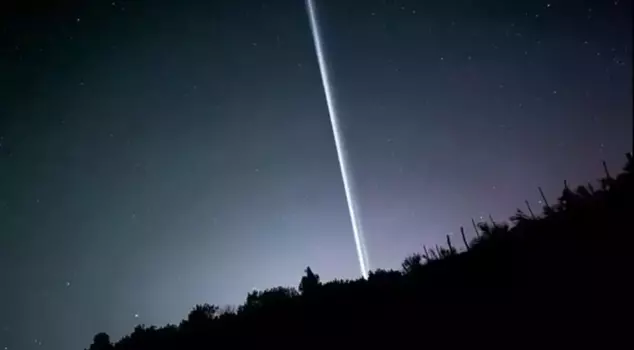
A mysterious beam of light was observed gliding across the sky throughout the United States. It was reported that this event occurred following the launch of the Zhuque-2E Y2 rocket by the Chinese startup LandSpace Technology, which uses methane and oxygen as fuel. It was stated that the most likely source of the light was the rocket's second stage, which occurred during the fuel dumping process.
Astronomy enthusiasts across the United States were astonished by a mysterious beam of light gliding through the sky.
On Saturday night, May 17, around 24:00, a bright line of light was observed over the southern regions of the U.S., extending as far as New Mexico.
Due to an unexpected geomagnetic storm activating the northern lights, many initially thought this line of light was STEVE. STEVE is a special type of light created by streams of charged particles, appearing white-purple in color.
However, astronomers have now revealed the true explanation for this strange event.
According to Dr. Jonathan McDowell, an astronomer tracking objects in space, the light was caused by a rocket dumping fuel.
About an hour before the light became visible, the Chinese startup LandSpace Technology launched the Zhuque-2E Y2 rocket, fueled by methane and oxygen.
Dr. McDowell notes that the most likely source of the light is the second stage of this rocket, which released "Methalox" rocket fuel at an altitude of approximately 250 km above the ground.
When released into space, the chemicals in the fuel react with the plasma in Earth's ionosphere, creating a spooky whitish glow, just like the one seen over the U.S.
When the glowing beam of light appeared in the sky, many astronomers' first thought was that they were witnessing a rare space weather phenomenon called STEVE.
On the night of May 17, Earth was experiencing a moderate (G2 class) geomagnetic storm due to the impact of materials from a solar flare.
The massive "winged" explosion, initially predicted to miss Earth, created a wave of material that was wider than expected and delivered a superficial blow to the planet.
Although STEVE is not part of the northern lights, it also originates from space weather and appears as a glowing river in a whitish-purple color in the sky.
Photographer Tyler Schlitt, who shared the event on X platform, wrote: "I saw STEVE with my friends in South Kansas, 45 minutes north of Greensburg!"
However, it quickly became clear that this was not a natural event.
Dr. McDowell explained on X: "The data confirms that the Zhuque-2 upper stage passed over the U.S. Four Corners region at 05:25 UTC on May 17 and is the source of the unusually bright cloud seen by many observers."
The Zhuque-2 rocket was launched by LandSpace Technology from the Dongfeng Commercial Space Innovation Test Site in northwest China at 04:21 UTC.
According to Dr. McDowell's follow-up, the upper stage of the rocket then passed northward over America at 05:24 UTC (local time 11:24).
Unlike most rockets, LandSpace Technology uses a mixture of liquid oxygen and methane called Methalox as fuel.
LandSpace Technology states that it is the first company in the world to successfully launch a Methalox rocket in 2023, marking the fifth flight of the updated Zhuque-2 rocket.
Methalox is increasingly preferred as a spaceflight fuel because it is cheaper, environmentally friendly, and potentially producible on Mars.
This means that crewed exploration teams heading to the Red Planet can save weight by not carrying fuel for the return journey.
There are two ways that fuel dumping can create a glowing line in the sky.
The first is if the fuel is dumped shortly after dawn or just after sunset, where frozen fuel crystals reflect light coming from the horizon.
However, since this glowing light appeared around midnight, this possibility is unlikely.
The second way Methalox can glow is through a chemical reaction of the fuel itself with components of the upper atmosphere.
When carbon, hydrogen, and oxygen—the components of Methalox fuel—enter the charged part of the atmosphere known as the ionosphere, they can react to produce light.
A team of physicists led by Paul Bernhardt from the U.S. Naval Research Laboratory in 2021 found that a fuel spray entering the ionosphere at night could "create a long-lasting glow observable from the ground or space."
Since the rocket dumped its fuel at an altitude of 250 km in the middle of the ionosphere, these reactions could explain why the fuel trail appeared so bright.
This is not the first time a rocket dumping fuel has created a spectacular display over the U.S.
SpaceX's Falcon 9 rockets also create impressive patterns that completely astonish ground observers.
The only difference is that SpaceX's fuel dumps typically create wide spiral patterns instead of the straight, glowing line seen on Saturday.