27.01.2026 18:30
When the waters receded at the Atatürk Dam in Adıyaman, 'T' shaped stones emerged, similar to those found at Göbeklitepe in Şanlıurfa. It was announced that the stones, revealed following a fisherman’s tip-off, date back to 9,000 BC, or 11,000 years ago.
When the waters of the Atatürk Dam in Adıyaman receded, a historical structure emerged that excited scientists. Stone walls, believed to belong to the same period, were detected about 150 meters away from the found 'T' shaped statues, submerged in the dam water.
THE FISHERMAN'S REPORT REVEALED A 11,000-YEAR-OLD STRUCTURE
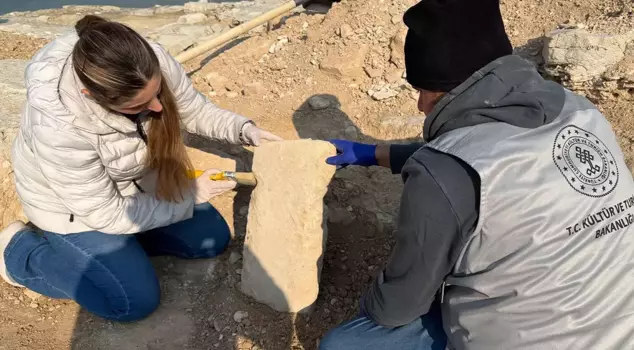
Upon a fisherman's report, teams from the Adıyaman Museum Directorate, conducting an examination near the Atatürk Dam, identified a historical structure dating back 11,000 years on the Samsat district shore of the dam. Under the scientific consultancy of Prof. Dr. Sabahattin Ezer from the Archaeology Department of Adıyaman University, the teams conducting rescue excavations unearthed two 'T' shaped stones and began to exhibit them in the ancient city of Perre. The identified area has been declared a protected site by a board decision, and it is expected that scientists will conduct surface research in the region. In 1965, a statue resembling the 'Kilisik statue' found in Göbeklitepe was also discovered by villagers and handed over to the Adıyaman Museum.
"WE HAVE ARCHAEOLOGICAL TRACES BELONGING TO THE SAME CULTURE AS GÖBEKLİTEPE"
In statements regarding the subject, Prof. Dr. Sabahattin Ezer from the Archaeology Department of Adıyaman University said, "This area excites us a lot; we think it is a very important settlement. We currently have archaeological traces that are contemporary and belong to the same culture as the period that has been revealed alongside the now-popular Göbeklitepe, which is referred to as the Taştepeler culture. Of course, the two small structures we found give us preliminary information. We need a more extensive research. We will be dealing with that. Here, we see two bowl-shaped depressions surrounded by slab stones. Among those slab stones, we also see a small standing stone in the shape of a 'T'. All of this proves to us that the same culture revealed in the Taştepeler in Urfa is also present here.
"WE WONDER IF THE MAIN SETTLEMENT HERE WAS GÖBEKLİTEPE"
We are talking about two very small structures. But just 150 meters behind us, we have detected stone walls currently submerged under the dam waters. We were able to go a little inside there. In the available areas, we mixed the mud there and did not encounter any pottery. It is very early to say anything definitive, but the absence of pottery suggests that the main settlement of the structures here might date back to the Neolithic period without pottery, which we can date to around 9,000 BC, meaning it belongs to 11,000 years ago. We are wondering if that was the main settlement. As we said, a comprehensive archaeological surface survey and possible geophysical studies in certain areas will allow us to identify the main settlement here," he said.
"OUR AIM IS TO TRY TO SAVE THE EXISTING STRUCTURES BEFORE THE WATERS RISE"
Mustafa Çelik, Deputy Director of the Adıyaman Museum, also stated, "Upon the report of a fisherman, we conducted a study in this area. In our study, we directly observed a T form on the surface. It was similar to the forms found in Göbeklitepe. The area in question was originally about 2 or 3 meters underground. However, due to the dynamic effect created by the rising and falling of the dam waters, the topsoil was pulled back, revealing the existing forms we found here. Our aim right now is to try to save the existing structures before the waters rise," he said.