13.02.2026 20:03
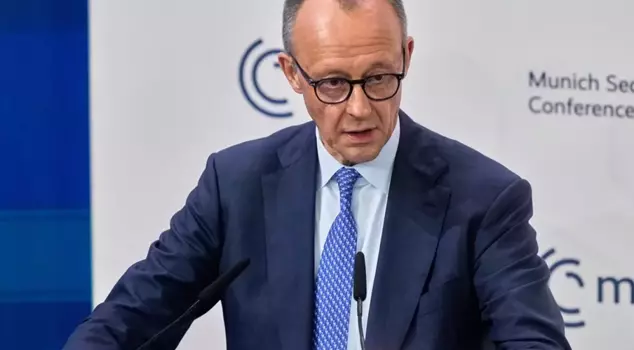
German Chancellor Friedrich Merz, at the Munich Security Conference, where he indicated that relations with the United States should be reestablished during a time when the old global order is collapsing, called for Europe to turn towards new partnerships, stating, "Turkey, Canada, Japan, India, Brazil, and South Africa will play a key role in this regard."
The 62nd meeting of the Munich Security Conference (MSC), considered one of the world's most important platforms for discussing defense, security, and foreign policy, officially began with the opening speech of German Chancellor Friedrich Merz.
"THE INTERNATIONAL RULE-BASED ORDER NO LONGER EXISTS IN ITS ORIGINAL FORM"
Merz, indicating that this year's theme of the conference is the global order in a process of destruction, addressed the Russia-Ukraine War and the impact of the U.S. and China on world politics in his opening speech. He pointed out that the international rule-based order no longer exists in its original form, stating, "The international order based on rights and rules is on the brink of collapse. I must clearly express that this order is not even present today in its flawed form."
"WE ARE ARRIVING AT DIFFERENT CONCLUSIONS THAN THE WASHINGTON ADMINISTRATION"
Pointing out that Europe needs to position itself in the changing balance of power in the world, Merz said, "As Europeans, we are taking our measures in this new era. In this process, we are arriving at different conclusions than those reached by the Washington administration. Our first task is to accept this new reality. This does not mean we accept it as an unchangeable future. We are not resigned to this world. We can shape it. I have no doubt that we will protect our interests and values in this world. At the very least, if we confidently rely on our own strength, we can withstand strong winds and protect our freedom. We will open new doors, seize new opportunities, and if we do it right, we will emerge from this test even stronger," he said.
In his assessment of Europe's new era, Merz noted that his country said "yes" to leadership based on partnerships, stating, "We say no to hegemonic dreams. As Germans, we will never act alone. This is a lasting lesson we have learned from our history."
HE CALLED FOR EUROPE TO TURN TO NEW PARTNERSHIPS AND POINTED TO TURKEY
Emphasizing that Europe's integration and transatlantic partnership will no longer be sufficient to protect freedom on their own, Merz stated, "This allows us to approach new partners with whom we will share important concerns, even if we do not share all our concerns. This creates opportunities and possibilities for both sides while preventing dependencies and risks, thus protecting our freedom. Turkey, Canada, Japan, India, Brazil, South Africa, and Gulf countries will play a key role in this regard. We want to work more closely with these countries with a long-term perspective based on mutual respect. We are interested in a political order where we can rely on agreements, solve global problems together, and above all, resolve conflicts peacefully," he expressed.
"A DEEP CHASM HAS EMERGED BETWEEN EUROPE AND THE U.S."
Recalling that steps have been taken as the European Union (EU) for a strong, sovereign European policy, Merz addressed transatlantic relations. He stated, "A deep chasm has emerged between Europe and the U.S. However, we can only solve global tasks together. For our partnership to have a future, we must rebuild it in two ways. This rationale must be concrete, not abstract. Together we are stronger; Europeans know how valuable trust in NATO is. In the age of great powers, the U.S. will also need this trust. When they act alone, even they reach the limits of their power. At least the strategists at the Pentagon seem to be aware of this. NATO is not only our advantage but also a competitive advantage for our dear American friends. The strongest alliance of all time is fully aware of how valuable this is. Times will not change for the U.S. either," he explained.
HE MADE A CALL TO RESTART RELATIONS WITH THE U.S. IN ENGLISH
Merz continued his speech in English, addressing the U.S. delegation in the hall. He said, "For three generations, trust among allies, partners, and friends has made NATO the strongest alliance of all time. Europe deeply knows how valuable this is. In the age of great power competition, even the U.S. is not strong enough to act alone. NATO is an advantage not only for Europe but also for the U.S. Therefore, our call is this: We must renew and revitalize transatlantic trust together; Europe is doing its part."
MINISTER OF TREASURY AND FINANCE MEHMET ŞİMŞEK WILL SPEAK
The 62nd Munich Security Conference, where global issues and solutions are evaluated, is being held at the Bayerischer Hof Hotel in Munich with more than a thousand participants from 120 countries. The conference includes approximately 60 government officials and heads of state, with foreign ministers from 65 countries and defense ministers from 30 countries in attendance. According to the official program of the conference, tomorrow evening, Turkey's Minister of Treasury and Finance Mehmet Şimşek will speak in a session on the future of Syria. The Chairman of the National Defense Commission of the Turkish Grand National Assembly, Hulusi Akar, and the Chief Advisor to the President on Foreign Policy and Security, Akif Çağatay Kılıç, are also participating in the conference.
KEY FIGURES SHAPING EUROPE'S POLICIES WILL ALSO BE IN MUNICH
Key figures shaping Europe's policies, such as Ukrainian President Vladimir Zelensky, German Chancellor Friedrich Merz, French President Emmanuel Macron, Polish Prime Minister Donald Tusk, Danish Prime Minister Mette Frederiksen, NATO Secretary General Mark Rutte, EU Commission President Ursula von der Leyen, and EU High Representative for Foreign Affairs and Security Policy Kaja Kallas, will also be in Munich.
The U.S. is participating in the Munich Security Conference this year with an official delegation led by Secretary of State Marco Rubio.
Rubio is expected to give a speech tomorrow regarding the future of NATO and his country's perspective on international issues and proposed solutions. There will be no participation from Russia and Iran at the conference, where Chinese Foreign Minister Wang Yi is also set to speak.
WHAT TOPICS WILL BE DISCUSSED?
Among the topics to be addressed at the Munich Security Conference are developments related to Greenland, which has been at the forefront of global issues in recent months due to U.S. plans, and the security of the Arctic, the current status of efforts to end the Russia-Ukraine war, the situation in the Middle East and the reconstruction of Gaza, as well as Europe's security, the future of transatlantic relations, the competitive state of the global economic order, regional conflicts, hybrid threats, and developments in the defense industry. The conference is expected to last three days.