17.03.2026 10:21
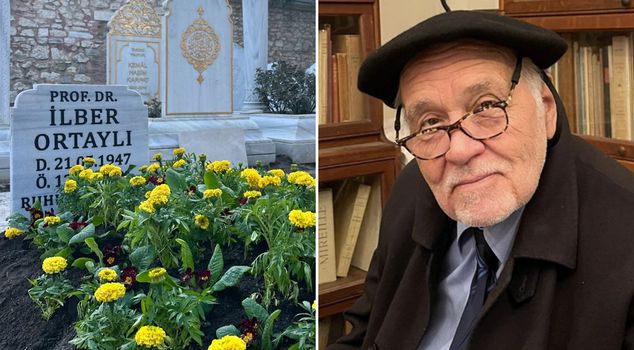
Soil brought from two symbolic geographies that Prof. Dr. İlber Ortaylı, the esteemed historian, valued throughout his life and dedicated significant attention to in his works, was laid on his grave. The soil taken from Çanakkale and his ancestral homeland Crimea was placed on Ortaylı's grave in the cemetery of the Fatih Mosque, referred to as the "heart of history," accompanied by prayers.
The distinguished historian Prof. Dr. İlber Ortaylı was buried in the Fatih Mosque cemetery, referred to as "the heart of history," following the ceremony. Ortaylı, considered one of the most important figures in Turkey's history and culture, was honored with a meaningful tribute during the burial that moved everyone.
SOIL FROM THE ÇANAKKALE MARTYRS' CEMETERY AND CRIMEA WAS SPRINKLED
Soil brought from two symbolic geographies that Ortaylı valued greatly throughout his life was sprinkled on his grave. Soil taken from the Çanakkale Martyrs' Cemetery and soil specially brought from his ancestral homeland Crimea were placed on his grave accompanied by prayers.
Many names from the worlds of academia, art, and politics, in addition to state officials, attended the ceremony. Participants expressed that Ortaylı held an important place in cultural memory not only as a historian but also for his knowledge and guidance. After the burial procedures, his loved ones gathered at his grave to pray for the master historian.
The passing of İlber Ortaylı created deep sorrow in the world of history and culture, while the works and ideas he left behind will continue to illuminate future generations.
WHO IS İLBER ORTAYLI?
İlber Ortaylı (May 21, 1947, Bregenz - March 13, 2026, Istanbul) was a Turkish historian and author. Ortaylı was an honorary member of the Turkish Historical Society, a board member of the International Ottoman Studies Committee, and a member of the European Society for Iranian Studies and the Austria-Turkey Science Forum.
He was born on May 21, 1947, in the city of Bregenz, Austria, under Allied occupation. His mother, Şefika Ortaylı (1918-2020), is of Caucasian Karachay descent. She belongs to the Şirinski family, one of the prominent noble families of the Crimean Khanate, which was granted princely titles by the Tsars. Şefika Ortaylı studied Russian language and literature in Stalingrad. His father, Kemal Ortaylı, was an aircraft engineer born in Crimea, who translated works and articles on Crimean history and Tatars into Turkish.
At the age of two, he immigrated to Turkey with his family. He completed his primary and secondary education at the Istanbul Austrian High School. He graduated from Ankara Atatürk High School in 1965.
His mother worked for many years as a Russian language teacher in the Department of Russian Language and Literature at Ankara University. Ortaylı grew up in a household where Turkish, German, and Russian were spoken. He has three siblings named Enver, Emeldar, and Nuriye.
In 1981, he married Ayşe Özdolay, the daughter of Mersin senator Dr. Talip Özdolay, and they had a daughter named Tuna. After an eighteen-year union, they divorced in 1999. İlber Ortaylı also had a large collection of miniature cars that he had passionately and meticulously collected since childhood.
On December 5, 2025, he was hospitalized due to inflammation in his leg. Ortaylı announced that he would be discharged shortly. He was admitted to Koç University Hospital in early March 2026 due to complications following prostate surgery in January 2026, diabetes, and chronic kidney failure. He received treatment in intensive care for about 5-6 days and was intubated around March 9, 2026. On March 11, 2026, journalist Fatih Altaylı stated that Ortaylı was experiencing serious health issues and requested prayers for him. On the same day, Ortaylı's family announced that he had been in intensive care for five days and that his condition was stable. His condition worsened, and he passed away on March 13, 2026, due to multiple organ failure.
In an official statement made by his family, it was said: "We lost our elder İlber Ortaylı on March 13, 2026. Despite long-lasting and increasingly complex health issues, his curiosity about life and desire to be with people never diminished, and he lived as best as he could."