30.04.2026 12:25
In a first during recent clashes with Israel, Hezbollah deployed small drones controlled via fiber optic cables. These drones, which cannot be stopped by electronic jamming systems, can fly low and fast to approach targets. Experts say this technology, which became widespread in the Ukraine war, poses a serious threat to Israeli soldiers and the border line.
A new weapon has emerged in the recent clashes between Israel and Hezbollah. It has been reported that Hezbollah has started using small drones with fiber optic cables, unaffected by electronic jamming systems, along the northern Israel and Lebanon border line.
CONTROLLED VIA FIBER OPTIC CABLE
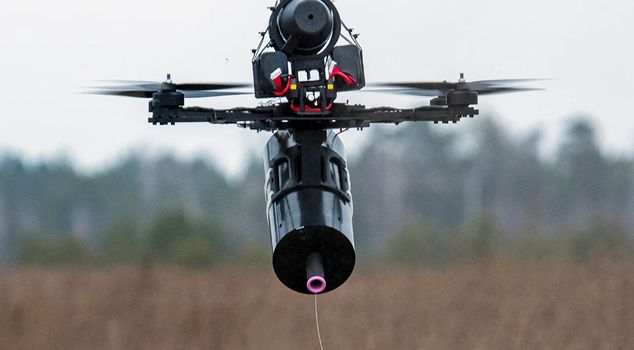
Hezbollah has begun using small drones controlled by fiber optic cables in its attacks on northern Israel. These drones, connected to the operator by cables as thin as dental floss, are not directed by electronic signals, unlike classic remote-controlled systems. Therefore, the electronic jamming methods applied by air defense systems cannot disable these drones. Under normal circumstances, many drones can fall or return to their launch point due to signal jamming. However, because there is a direct physical connection between the operator and the vehicle in fiber optic cable drones, electronic intervention remains ineffective.
A NEW AND DIFFICULT THREAT FOR ISRAEL
An Israeli military official said that fiber optic drones are a relatively new threat emerging during the recent conflict period with Hezbollah. According to the official, Hezbollah has turned to these smaller, harder-to-detect systems because Israel's air defense has been successful against large rockets, missiles, and classic drones. Israel assesses that these drones are produced locally and are easy to prepare. It is stated that these systems can be produced with a simple ready-made drone, a small amount of explosives, and transparent cables available on the market.
“DEADLY IF USED CORRECTLY”
Robert Tollast, a drone expert and researcher at the London-based Royal United Services Institute, stated that these systems can approach targets at low altitude, adding, "It is definitely deadly if you know what you are doing." According to experts, two main methods stand out against these drones: physically hitting the drone or cutting the nearly invisible fiber optic cable. However, the small size of the drones, their low-altitude flight, and short routes make early detection and prevention difficult.
WIND AND CABLE TANGLING ARE WEAK POINTS
Fiber optic drones cannot be electronically jammed, but they are not completely flawless. Wind, environmental obstacles, or contact with other drones can cause the thin cables to tangle. Nevertheless, it is stated that these systems pose a serious threat on the battlefield. It is reported that Hezbollah uses these drones mostly against Israeli soldiers operating in southern Lebanon and settlements along the border line.
TECHNOLOGY SPREAD FROM THE UKRAINE WAR TO THE FRONT
Fiber optic drones were widely used in the Ukraine war. In the ongoing technology race between Russia and Ukraine, these drones, developed to bypass electronic jamming systems, have gained significant importance on the battlefield. Images have emerged from some front-line towns in Ukraine showing fiber optic cables covering the area like a spider web. According to experts, in some instances, these cables have been observed extending up to 50 kilometers.
ISRAEL'S DEFENSE FALLS SHORT
Ran Kochav, a former air defense commander in the Israeli army, said that Israel struggles to defend against fiber optic drones. Kochav noted that these vehicles fly very low and fast, and due to their small size, they are extremely difficult to detect. According to Kochav, Israel focused on strengthening its air defense against rocket and missile threats for many years, but the drone threat was not given the same priority. Arguing that Israel should have monitored the development of fiber optic drones in the Ukraine war more closely, Kochav stated that it should have been anticipated that Iran-backed groups could also use this technology.
NET AND CAGE MEASURES FOR MILITARY VEHICLES
The Israeli army is working on technological solutions against the fiber optic drone threat. However, in the meantime, net and cage-like physical protection systems are being added to military vehicles to protect soldiers in the field. According to experts, Israel possesses technologies capable of recognizing drone propeller sounds, monitoring light changes, and analyzing communication signals. However, it is noted that these systems have not been deployed widely enough along the northern border.
HEZBOLLAH SHARED ATTACK FOOTAGE
In recent weeks, Hezbollah has released footage of attacks carried out with fiber optic drones via social media platforms and Al-Manar television. These attacks specifically targeted Israeli soldiers operating in southern Lebanon. In an attack last weekend, one Israeli soldier was killed and six were wounded. In another attack on Tuesday, an Israeli civilian contractor lost his life in southern Lebanon. Hezbollah announced that it used fiber optic-guided drones for the first time during the recent conflict period that began on March 2.
CRASHED INTO THE GARDEN OF A HOUSE IN NORTHERN ISRAEL
Zevik Glidai, a 78-year-old mathematics teacher and volunteer ambulance driver living in the city of Kiryat Shmona in northern Israel, found transparent fiber optic cables around a drone that crashed into his garden on April 13. Glidai, who lives about 2 kilometers from the Lebanese border, said he heard a high-pitched sound followed by a small impact while sitting at home. After a neighbor informed him that a fire had started in the garden, the two put out the fire with a hose. Glidai said they saw white thread-like cables around the wreckage and noted that the drone crashed without any warning siren sounding. Bomb disposal teams considered it a great stroke of luck that the approximately 2 kilograms of explosives on the drone did not detonate.