13.08.2026 14:51
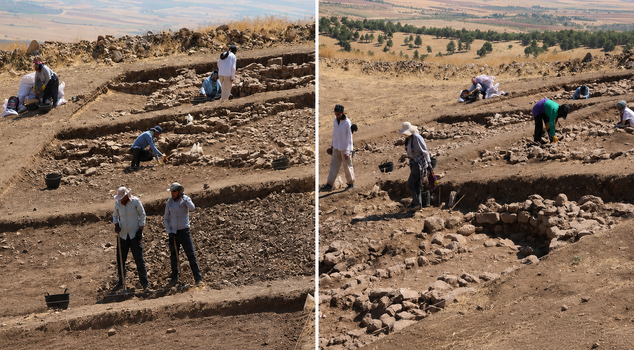
In Göbeklitepe, which is on the UNESCO World Heritage List, structures with rectangular plans from the second phase of the settlement have been uncovered during work carried out in a new area north of the main excavation site. Excavation Director Prof. Dr. Necmi Karul stated that these structures might have been used as dwellings based on initial impressions, indicating that Göbeklitepe was not only a worship center but also a settlement.
In the excavations carried out in a new area at Göbeklitepe, which is on the UNESCO World Heritage List and described as the "zero point of history," rectangular-plan structures dating to the second phase of the settlement have been unearthed.
Prof. Dr. Necmi Karul, Coordinator of the Stone Hills Project and Head of the Göbeklitepe Excavations, told an AA correspondent that while work continues in the main excavation area under protection at Göbeklitepe within the scope of the Ministry of Culture and Tourism's Legacy to the Future Project, excavations have also begun this season in the new area to the north of the roof.
Karul stated that by moving the olive trees previously found in the existing area to another region, an environment suitable for excavation was created, and they started work in the new area of approximately 1500 square meters this season.
Emphasizing that with these excavations they aim to re-test and discover the potential of Göbeklitepe's previously revealed structures, Karul stated that they are also applying the working method here based on excavating large areas and deepening over time.
"OLIVE TREES HAVE NOT CAUSED GREAT DESTRUCTION IN THE REGION"
"We started from one edge of the area. We are continuing towards the north, and right beneath the surface, we have uncovered rectangular-plan structures dating to the second phase of Göbeklitepe. Their being just beneath the surface has allowed us to reach evidence that quickly gives an idea about the plan and settlement layout. In fact, the floors of some structures were reached very quickly, because this place is prone to erosion. The upper levels of the walls were worn away a long time ago.
Another piece of good news is that we saw that the olive trees did not cause great destruction here. However, we also saw that if the trees had not been moved from here, this would have been an area that could not have been excavated at least. Our plan this year is to remove the surface level across the entire area you see behind and uncover the structural remains just beneath the surface."
"OUR FIRST IMPRESSION IS THAT THESE WERE USED AS DWELLINGS"
Karul stated that the walking path surrounding the new excavation area has been planned so that visitors can closely observe the work and the new finds to be unearthed.
Stating that they encountered similar rectangular-plan structures in the area called GT1 in previous years, Karul continued as follows:
"We are talking about their similar ones. But as far as we have seen so far, we can say that this tradition of standing stones has weakened, they contain fewer standing stones, and when we look at the internal arrangement of the spaces, they may have been used more for residential purposes. But of course, it is not enough to say this just by uncovering the walls. The soil samples we collect, especially from inside these structures, will give us information about the functions of the spaces. This is something we can say more when we reach the floor level, with samples we take from the floor. Our first impression is that these were used as dwellings."
Karul stated that at Göbeklitepe, besides public structures, contemporaneous dwellings were also unearthed in previous excavations, and the simultaneous use of public structures and dwellings shows that Göbeklitepe was not only a worship center but also a settlement where people lived, and that a similar settlement layout is seen in other excavations within the scope of Stone Hills.
Reporting that work continues at Göbeklitepe, especially in the area with round-plan structures on the slope, Karul added that the consolidation work, largely completed in Structure C last year, is continuing in Structure D this year and is planned to be completed by the end of the year.