15.12.2025 18:36
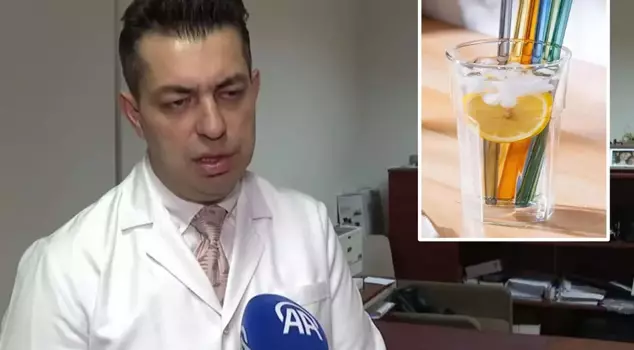
It has been warned that glass straws pose a risk of breaking due to dental contact, impact, and temperature differences, and that if they break, they can cause injuries to the mouth and digestive system, especially advising against their use in children and individuals who require care.
Gülhane Training and Research Hospital of Health Sciences University (SBÜ) Faculty Member Assoc. Dr. Onur Tezel stated that glass products, especially glass straws, can cause serious injuries in the mouth and digestive system if broken due to misuse or various accidents.
"THE RISK OF CRACKING IS QUITE HIGH"
Tezel expressed that the fractures that occur are not always visible to the eye and that micro-cracks can form in some cases. He pointed out that the risk of breaking can vary depending on the materials used in the production phase of the glass material, stating, "Especially in small children, there is a chewing habit left over from plastic straws. With this chewing motion, glass straws can break. At the same time, due to the nature of glass itself, the risk of cracking is quite high when we take it from a very hot environment, for example, when we wash it in the dishwasher and suddenly put it into a cold material."
"IT CAN PROGRESS FROM THE STOMACH TO THE INTESTINES"
Tezel indicated that when the glass product comes into contact with the mouth, the hard structure of the teeth can make existing fractures more pronounced, stating, "The biggest problem of a fracture in the mouth is that the soft tissues, which we call the palate, tongue, and back areas, are very susceptible to injury. Therefore, even the smallest fracture can cause damage to soft tissues because glass has a sharpness like a razor. Our worst-case scenario is the swallowing of the broken glass piece. With swallowing, the glass piece first goes to the esophagus, and if it does not get stuck, it descends to the stomach and can progress to the intestines."
"IT CAN CAUSE SERIOUS BLEEDING"
Tezel expressed that intervention for injuries in these areas is difficult, stating that the inside of the mouth and the esophagus can be evaluated with endoscopic procedures, but if the glass piece passes through the stomach and comes into contact with the intestines, in some cases, the process can progress to surgical intervention. Tezel noted that there are important vascular structures in this area that provide nourishment to the esophagus, and if the glass piece gets stuck in this area, it can lead to serious bleeding.
"THE PERSON NEEDS TO BE TAKEN TO THE EMERGENCY ROOM AS SOON AS POSSIBLE"
Tezel explained that due to the bleeding potentially progressing towards the stomach in the initial stage, the person may not immediately notice their condition, stating that in some cases, patients may present to healthcare institutions with shock due to blood loss or complaints of vomiting blood.
Tezel shared the following information regarding what to do in case of swallowing broken glass: "In this case, the person needs to be taken to the emergency room as soon as possible. They should not attempt to remove the glass themselves or try to vomit. If it has been swallowed, trying to bring it back up from the stomach contents or esophagus will also damage the tissues due to the movement of that glass. Glass materials should never be used if there is a suspicion of a fracture, deformity, or appearance resembling a crack. In general, we do not recommend using straws. Drinking from a glass is always the best."
"IT IS NECESSARY TO AVOID HARD STRAWS AS MUCH AS POSSIBLE IN PATIENTS IN NEED OF CARE"
Tezel pointed out that straws are also used for individuals in need of care, stating, "Patients with dementia, Alzheimer’s, and those in need of care may not be aware of what they are touching due to their poor state of consciousness. When they are injured or have damage to their palate, it becomes more difficult to diagnose because they do not realize it. In the use of straws for patients in need of care, it is necessary to avoid glass straws or hard straws that can damage the palate as much as possible."