03.02.2026 13:50
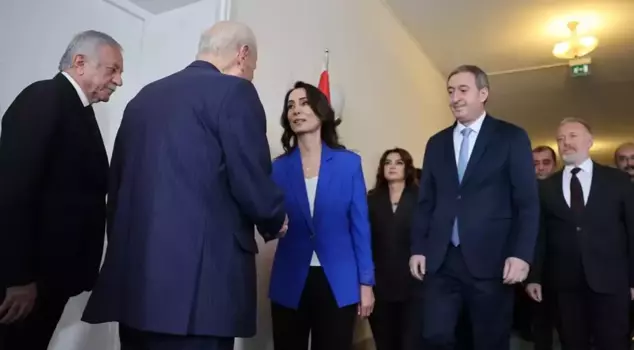
Tuncer Bakırhan, Co-Chairman of the DEM Party, spoke at his party's group meeting. Referring to the statements made by MHP leader Devlet Bahçeli at today's group meeting, Bakırhan said, "The 'right to hope' mentioned by Mr. Bahçeli is valuable for us in a Turkey that has been freed from the shame of trusteeship and where political prisoners have been released. Bahçeli's interlocutor is the government; the government must take action without delay for Mr. Bahçeli's valuable observations."
DEM Party Co-Chair Tuncer Bakırhan evaluated the words of MHP leader Bahçeli at his party's TBMM Group Meeting: "Anatolia is for peace, Öcalan is for hope, Ahmetler are for position, and Demirtaş is for returning to his home; our decision is clear until then."
"ACTION MUST BE TAKEN WITHOUT DELAY FOR BAHÇELİ'S OBSERVATIONS"
Expressing that Bahçeli's call is directed at the government, Bakırhan stated, "Turkey must now spend its energy not on Damascus but on Ankara. Ankara must focus on the solution. The Ankara solution creates a domino effect. The government no longer has a basis for security concerns centered on Syria. No one has an excuse left regarding concrete and reassuring steps. Legal work that will provide rights to the Kurds and democracy to Turkey must now be activated. Before us, Mr. Bahçeli spoke at this podium. The 'right to hope' that Bahçeli mentioned is valuable to us as well, in a Turkey that has been freed from the shame of trusteeship and where political prisoners are released. Mr. Bahçeli's addressee is the government; the government must take action without delay for Bahçeli's valuable observations. The recognition of identity, language, and culture, and the strengthening of local democracy is the only way for a people to feel safe and at home," he said.
REACTION TO DETENTIONS
The main points of Bakırhan's speeches are as follows:
"This morning, following home raids, nearly 100 of our friends, including ESP Co-Chair Murat Çepni and our PM member Emin Orhan, were detained in operations targeting the Socialist Party of the Oppressed (ESP), the Federation of Socialist Youth Associations (SGDF), the Socialist Women's Assemblies (SKM), the Limter-İş Union affiliated with DİSK, the Active News Agency (ETHA), Polen Ecology, BEKSAV, and various institutions.
The economy is not doing well. Strikes are taking place in factories and workplaces almost all over Turkey. Migros warehouse workers are also protesting because they are not working under humane conditions and are not receiving the fruits of their labor. We want to state that we stand with the Migros warehouse workers and will be with them until they receive their rights.
EVENTS IN SYRIA
In 2026, we are witnessing shocking developments in many parts of the world. Especially in Rojava, we are experiencing very important days concerning the Kurds and the region. The attacks that began on two neighborhoods inhabited by Kurds in Aleppo have turned into massacre, forced migration, and siege.
In response to this wave of attacks, solidarity actions with Rojava have been ongoing around the world for days. And these actions have brought along the questions, "Why are the Kurds protesting, what do the Kurds want?" The answer to these questions is hidden in the political order built on the denial of the Kurds over the last century. The Kurds' objection is directed against the denial and statelessness that has been imposed for a century. Until today, the Kurds have stood shoulder to shoulder with the peoples they live with in the history of the countries they are in; they have paid the price, resisted, and continuously changed the balance in favor of the peoples they coexist with when there was war, crisis, or security threats. But when the time came to establish a new order, the same Kurdish existence was suddenly seen and declared as a "strategic threat and political burden." The people who were called a lifeline yesterday were turned into a threat the next day.
Let’s rewind time and wander a bit through historical crossroads: In 1919–1922, the Kurds, who were a liberation force, were pushed outside the law in 1923. In 1937 with the Sadabad and in 1955 with the Baghdad Pact, we witnessed how states set aside their contradictions and united against the Kurds. Whether it was the 1946 Mahabad Republic experience or the 1975 Algiers Agreement, we saw how the fate of a people was sacrificed on negotiation tables. We painfully experienced how the stones leading to the 1988 Anfal Genocide and Halabja were laid with "diplomatic silence." The targeting of the Kurdish liquidation by the February 15 International Conspiracy is still fresh in our memories. And after 2015, we saw how the world isolated the Kurds while those defending humanity against ISIS gangs in Syria were being occupied in their places. The last link of these historical truths became the January 10, 2026 Paris Agreement. The Paris Agreement is a repetition of a century-long diplomatic abandonment. But one thing did not repeat: The Kurds rose everywhere by saying no to this hypocritical cycle. They are risking their lives in the field and protesting being ignored at the table. They say let the conspiracies and tricks end.
The Kurds want to live in the states they inhabit not as victims of conspiracies but as equal citizens. They want to speak their language, live their identity, preserve their culture, and see the recognition of their existence.
"TODAY WE FACE TWO VERY IMPORTANT LESSONS"
Today we face two very important lessons. The first is this: The lesson that the exclusion of the Kurds from diplomatic tables brings neither lasting peace to the Kurds nor to the region. The second is this: Continuously suppressing or ignoring the legitimate demands of any people, regardless of which people it is, does not eliminate the problem; on the contrary, it produces a spiral of conflict that lasts for generations. That is why denial in Syria, suppression in Iran, strangulation in Iraq, and denial in Turkey are the current forms of a century-old paradigm. Therefore, today we must learn lessons from history. The demands of the Kurdish people and oppressed peoples are not demands for privilege. The solution lies not in suppression but in mutual respect and dialogue.
Ensuring the observance of social, political, and local rights within the framework of the announced gradual integration in Syria will strengthen the democratic balance. Achieving a lasting ceasefire, stopping the pressures, and ultimately preventing people from dying is the most important gain. In this context, we hope for the swift return of the displaced, especially in Afrin and Serêkaniyê. The administrative status of the Kurds and the right to education in their mother tongue is also a guarantee of a united Syria. This agreement is a beginning; the democratic spirit of this agreement should spread to all the peoples and beliefs of Syria. As the DEM Party, we support this agreement. In the implementation phase, we will stand by every step that expands the negotiation, protects the will of the peoples, and serves the common future of Syria.
"WE THANK ÖCALAN"
Since January 6, there has been a great humanitarian resistance in Rojava. The world has clearly understood this reality: Rojava is the apple of the Kurds' eye. The Kurdish people and their friends have protested for Rojava everywhere in the world, filling the streets and squares. With this will, the Kurdish people have raised the spirit of National Unity higher than ever in history. For days, the slogan "Yeke yeke, gele Kurd yeke" in the squares has turned into a consciousness that shows how necessary the spirit of national unity is. And for this consciousness to turn into political will, a great responsibility falls on Kurdish politicians and institutions. It is time to establish the Kurdish National Unity that will win a century of freedom against a century of imposed slavery. Now all parties and movements must crown the national spirit that emerges in the streets and squares with national unity.
If today the Kurds and Arabs are not in a civil war in Syria, and if the rights of the Syrian people are recognized, it is due to the stance that Mr. Öcalan has shown on the island, for which we thank him. Today, it is our duty to uphold the democratic solution perspective presented by Mr. Öcalan. Rigid centralism is the poison of communal living.
"A NURSE IS DETAINED FOR BRAIDING HER HAIR"
Now, I want to make a few warnings about a matter that concerns all of our futures, which is extremely sensitive and very important. Today, we are witnessing a deeper emotional fracture in society than ever before. More painfully, there are circles that consciously exacerbate this fracture, and unfortunately, these circles are tolerated. The hatred produced on social media, on screens, and in daily life is met with almost no objection. There is no legal sanction, no political shame, no moral brake. We absolutely do not accept this.
It must be said without beating around the bush: Unfortunately, there is both overt and covert racism in Turkey. Racism is being normalized everywhere; anger and lynching are being orchestrated against the Kurds. Look, a newspaper hostile to Kurds has labeled those participating in a support march with tens of thousands of people as "terrorists." The same newspaper employs a member of Al-Qaeda, who is on the Interior Ministry's wanted list, as a journalist.
"THERE ARE INSULTS AND CURSES, OUR LAWYERS CANNOT EVEN INITIATE AN INVESTIGATION"
The judiciary and the executive are silently approving racism against Kurds. There are dozens of insults and curses under every tweet we post. Our lawyers cannot even initiate an investigation. The judiciary and the executive should also deal with those who perpetrate racism. Has anyone seen any account that engages in racism against Kurds being closed? It is a paradox of Ankara to seek to establish internal peace with the Kurds while allowing racism. Overcoming this paradox is also the duty of the government.