17.02.2026 22:32
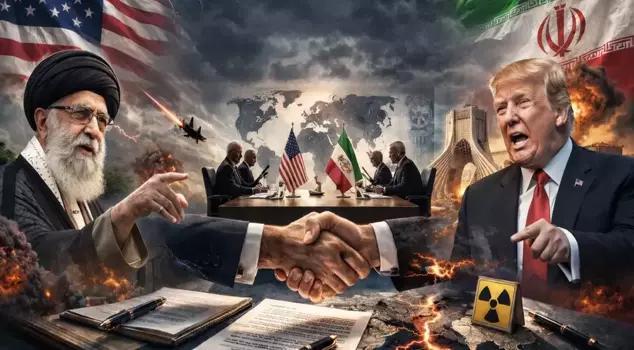
As the second round of nuclear negotiations between the US and Iran concluded in Geneva, Tehran sent a message of "consensus on fundamental principles." Iranian Foreign Minister Abbas Araghchi announced that progress had been made, while the White House emphasized that the process still contained many details. While the talks were ongoing, Iranian leader Ali Khamenei issued harsh threats; Iranian President Masoud Pezeshkian stated that they aimed for concrete results in the negotiations.
The second round of nuclear negotiations between the United States and Iran, which has drawn the attention of the entire world, has been completed in Geneva.
IRAN: WE HAVE AGREED ON BASIC PRINCIPLES
After approximately 2.5 hours of discussions, the first statement came from the Iranian side. Foreign Minister Abbas Araghchi stated that the talks had made "good progress" compared to the previous round. Araghchi noted that both sides agreed to work on draft texts for a possible agreement and to determine the date of the next round after mutual review of the texts. He added that both sides have positions that will take time to reconcile, but they have agreed on basic principles.
WHITE HOUSE: THERE ARE MANY DETAILS TO DISCUSS
The first statement on behalf of the U.S. came from the White House. An unnamed White House official stated, "Progress has been made in talks with Iran, but there are many details to discuss," adding that the Iranians would return within two weeks with detailed proposals to resolve their differences.
A THREAT FROM KHAMENEI: THE WEAPON THAT CAN SEND A AIRCRAFT CARRIER TO THE BOTTOM OF THE SEA IS MORE DANGEROUS
Meanwhile, while the negotiations were ongoing, a clear threat came from Iran's religious leader Ali Khamenei. Speaking to the public at his office in Tehran, Khamenei said, "The U.S. President, in one of his recent speeches, said, 'America has not been able to eliminate the Islamic Republic for 47 years.' He has almost complained to his own people. This is a good confession. I say to you; you will not be able to do this either."
Recalling that U.S. President Donald Trump said, "Our military is the strongest in the world," Khamenei stated, "Even the strongest army in the world can sometimes receive such a slap that it may not be able to get up. The weapon that can send an aircraft carrier to the bottom of the sea is more dangerous."
Khamenei noted that the U.S. has predetermined the outcome of the negotiations from the start, stating: "They say, 'Let's negotiate about your nuclear energy, and the outcome of the negotiation should be that you do not have this energy.' It is wrong and foolish to predetermine the outcome of the negotiation. You say, 'Let's talk about this issue, let's reach an agreement'; then why do you predetermine the outcome and say we must reach this conclusion? This is foolish. U.S. presidents, some senators, and other officials are doing this foolish thing."
PEZEŞKİYAN: WE ARE SERIOUS ABOUT REACHING A CONCLUSION AND HOPE THE NEGOTIATION PROCESS WILL LEAD TO TANGIBLE RESULTS
Iranian President Masoud Pezeshkian, referring to the negotiations held with the U.S. during a meeting with the country's clerics, stated, "The negotiations are being conducted with the approval of the Leader of the Revolution. Our goal is not to talk for the sake of talking, but to resolve issues. We are serious about reaching a conclusion and hope the negotiation process will lead to tangible results."
Additionally, Pezeshkian emphasized that they have good relations with neighboring and Islamic countries, stating that they have resolved many issues this way, and said, "The condemnation of Israel's attacks on Iran by countries and the efforts made by neighbors to reduce tensions in the region are a reflection of this cooperation."
THE NEGOTIATION PROCESS BETWEEN IRAN AND THE U.S.
The nuclear negotiations between Iran and the U.S., interrupted by attacks from Israel and the U.S. in June 2025, were revitalized through the initiatives of regional countries, especially Turkey, and with the mediation of Oman.
The parties met in Oman on February 6 for indirect negotiations and agreed to continue the contacts. In the meetings held in the capital Muscat, the delegations were in the same venue but in separate rooms, and messages were conveyed through Omani officials.
In the first round in Muscat, although the parties did not reach an agreement, they agreed to keep the negotiation channels open and to initiate technical-level work. The discussions particularly highlighted the rate of uranium enrichment and the status of high-enriched uranium stocks.
The parties decided to move the negotiations to Europe after the first round and meet in Geneva.