07.03.2026 16:12
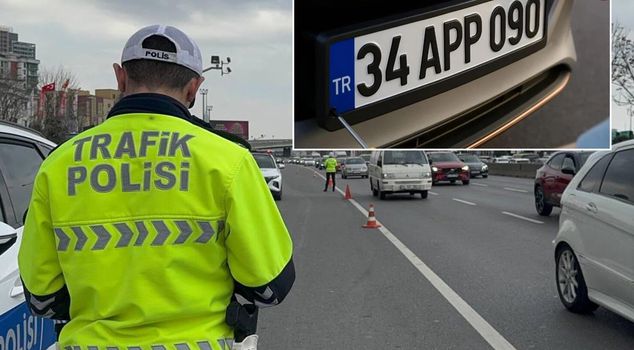
It was reported that, upon the instruction of Interior Minister Mustafa Çiftçi, non-standard APP license plate inspections will be conducted only for guidance purposes until April 1, and no fines will be imposed on drivers. In the regulation that came into effect to ensure public safety, it is required that APP plates, which do not have security features such as standard font, security hologram, and authorized organization seal, be replaced with standard-compliant plates by April 1 at the latest.
A new decision has been made regarding the traffic fines of 140 thousand lira imposed on drivers using APP plates.
Within the framework of the changes made to the Highway Traffic Law, starting from February 27, drivers with non-standard plates "American Press Plate" (APP) on their vehicles were subjected to a fine of 140 thousand lira, a 30-day confiscation of their driver's licenses, and a decision to ban the vehicle from traffic for 30 days. It was announced that in the case of a second violation within the same year, the penalty would be doubled.
In order to prevent citizens from being victimized, it was stated that no punitive measures would be applied to drivers until April 1, in accordance with the instructions of Interior Minister Mustafa Çiftçi. It was reported that inspections to be carried out by law enforcement would be conducted for training and information purposes until the end of March.
APP PLATES MUST BE CHANGED BY APRIL 1
In the regulation that came into effect to ensure public safety, APP plates must be changed to compliant plates with standard font, security hologram, and authorized organization seal by April 1 at the latest, as they do not possess these security features. The reason for the change is to ensure that standard plates can be accurately detected by electronic monitoring systems and city security cameras.
WHAT TO DO FOR PLATE CHANGE
Drivers with non-standard plates must first report the loss to Police Station Commanders or Gendarmerie Commanders. The next steps involve drivers who receive the plate printing request document from the notary applying to the chambers that carry out plate printing under the Turkish Drivers and Automobile Federation (TŞOF).
ONLY AUTHORIZED ORGANIZATIONS WILL DO IT
On the other hand, it is important for drivers not to trust individuals who promise to print plates for a fee on social media, as the process must only be carried out by authorized organizations.
LONG QUEUES FOR PLATE CHANGE HAVE FORMED
Following the increase in penalties for thick-font and illegally used APP plates, drivers have taken action. With the new regulation, a fine of 140 thousand TL is imposed on those using APP plates on the first detection, and 280 thousand TL for those caught a second time. Additionally, these vehicles can be banned from traffic. Drivers who heard about the fines rushed to change their plates at the drivers' chambers, resulting in long queues.
THE FINE FOR APP PLATE CAN BE UP TO 280 THOUSAND LIRA
Drivers using non-standard plates can face an administrative fine of 140 thousand TL for the first violation. Additionally, measures such as the confiscation of the driver's license for 30 days and the ban of the vehicle from traffic for 30 days can also be applied. It is stated that if the same violation is repeated within the year, the fine can rise to 280 thousand TL. In this case, there is a possibility of the driver's license being confiscated for a longer period and legal processes being initiated. Furthermore, there is a risk of imprisonment from 2 to 5 years under Article 204 of the Turkish Penal Code.
WHAT IS APP PLATE?
Plates known as APP plates are defined as plates printed outside standard dimensions and font characters, and do not carry official security elements. These plates are generally preferred for aesthetic purposes as they are prepared in thicker and different fonts.
Plates known to the public as "APP plates" have a different legal status. According to the fifth paragraph of Article 23 of the law, if the plates are not printed by an authorized organization, they are considered legally invalid. According to the statements of the General Directorate of Security, such plates are not accepted as compliant with official standards. Therefore, if their use is detected, administrative sanctions can be imposed on the drivers.