21.12.2025 16:55
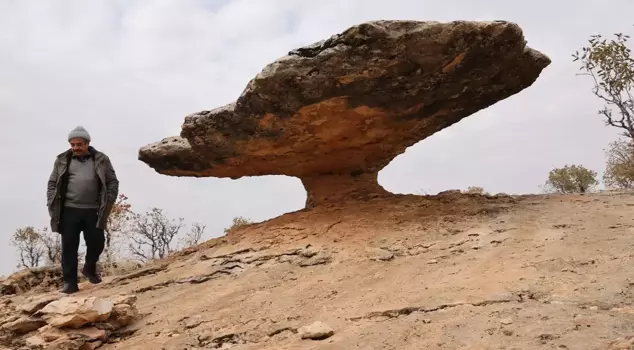
The large rock piece standing on a thin column in the Kocaköy district of Diyarbakır is considered a remnant of the Ice Age. The rock, which draws attention with its interesting structure, continues to rise and move northward.
Located about 4 kilometers from the center of Kocaköy district in Diyarbakır, the "mushroom rock" or "shield rock" attracts attention with its astonishing structure.
The large rock piece, standing on a thin column, has maintained its current form for years.
Anthropologist Naci Akdemir stated that the area consists of a substrate made up of sedimentary rock masses.
Akdemir noted that the terrain was formed by the pushing of the African-Arabian plate against Eurasia, stating that this terrain is currently both rising and moving northward.
"MOVING NORTHWARD AT A RATE OF 10-15 MILLIMETERS PER YEAR"
Anthropologist Akdemir emphasized that the process began approximately 250-300 million years ago, stating, "It continues to rise. According to scientists, the rate of progress is akin to the growth rate of fingernails. In other words, it is moving northward at a rate of about 10-15 millimeters per year. The structure we see here is one of the typical and most beautiful examples of what geographers call 'devil's table' or 'mushroom rock'."
"FORMED 6 MILLION YEARS AGO"
Akdemir, who stated, "These formations are primarily created by water and wind erosion, but in my opinion, this is also a result of glacial age erosion," added, "Because if we pay attention to the substrate we are currently on, there are no water flow lines or streams that would remind us of water erosion. Therefore, I see this formation as a structure from the glacial age. It was formed as a result of glacial erosion. We call it shield rock. It is likened to a shield, which is a war tool. This shield rock is one of the most important symbols of Kocaköy. It took this form about 5-6 million years ago. Because during this process, there was a Tethys Sea connecting the present-day Africa-Arabia with present-day Eurasia, between the Atlantic Ocean and the Indian Ocean. The Mediterranean is its remnant, its remains," he stated.