08.08.2024 15:00
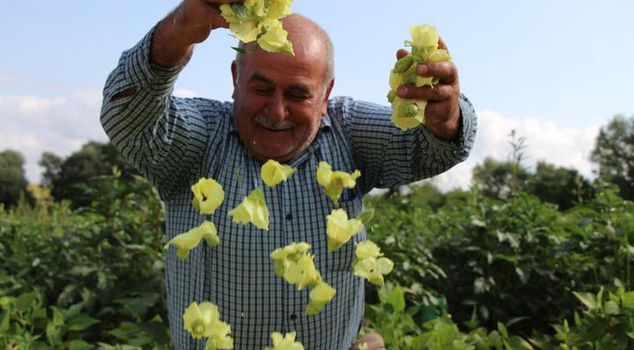
The harvest of the geographically registered flower okra, grown in the district of Taşova in Amasya, brought smiles to everyone's faces this year. Okra, which finds buyers at a price of 1000 TL per kilogram, contributes approximately 350 million TL to the city's economy.
The harvest of the geographically marked flower okra, grown in the Taşova district of Amasya, has brought smiles to people's faces this year.
Currently, dried okra is being sold for 1000 TL per kilogram, and it is called 'yellow gold' because it never loses its yellow color and monetary value. Okra finds buyers at any time of the day and is easier to sell than gold. Buyers can even come to the producer's door late at night. It is expected that more than 2,450 tons of okra will be produced in the province this year.
"JUST SAY 'HELLO' TO SELL IT"
Ahmet Taşova from the village of Belevi, who stated that dried okra finds buyers for 1000 TL, said, "Okra is our yellow gold. Because it is sold for cash. It can be converted into cash immediately, just like gold. Just saying 'hello' is enough. It can be sold day and night. You can't open a jeweler at night. But the okra seller can come to your house and buy it even at night."
Saadet Yılmaz, who mentioned that they start picking okra in the fields early in the morning, expressed her desire for this beneficial product to be consumed abundantly for health reasons.
CONTRIBUTION OF 350 MILLION TL TO THE ECONOMY
Yılmaz Doruk, the Governor of Amasya, who stated that more than 2,450 tons of flower okra will be produced from an area of 5,500 decares in the village of Belevi, announced that this product contributes approximately 350 million TL to the city's economy.
INDIVIDUALLY STRUNG ON A THREAD WITH A NEEDLE
Small okras, which are collected together with their flowers by producers in the early hours of the morning throughout the summer, are then strung on a thread with a needle and left to dry. The process of stringing the okras continues until late hours. Haluk İpek, the AK Party Member of Parliament for Amasya, who described the harvest of okra as very laborious, said, "Producers collect them one by one and string them on a thread. There is a lot of effort involved. They ask why okra is expensive. It is because picking, stringing, and drying it is very laborious."
"THERE IS A BIG DIFFERENCE WITH OKRA FROM UGANDA"
Cemalettin Bak, an okra producer from the village of Çaydibi, who explained that producers have been growing okra in Africa and bringing it to Amasya due to increasing costs, criticized the sale of these okras. He said, "The okra you see in the market right now is not Amasya flower okra. There is a big difference between the okra that comes from Uganda and the okra grown here. It becomes apparent when you put them side by side. Our local okra is collected in the sun and dried in the shade. It turns yellow. The okra from there is collected in the sun and dried, so it is darker, smaller, and has a smoky smell."
The harvest program held in the village of Belevi was attended by Ekrem Toto, the Provincial Chairman of the AK Party, and Gürol Çetin, the Provincial Director of Agriculture and Forestry.