25.12.2025 07:40
The pilot of the Falcon-50 private jet carrying the Libyan military delegation that crashed in Ankara made initial contact with the control tower at 20:31, issuing a "PAN-PAN" announcement, which is an emergency call in aviation. It was later learned that shortly after, the pilot activated the 7700 emergency code. Following the communication, the jet attempted to return to Esenboğa, but contact with the aircraft was completely lost at 20:38, and the pilot's last words were recorded as "The malfunction is very serious."
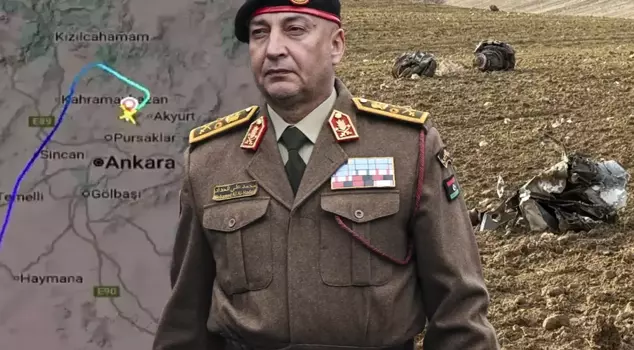
In Ankara, details have emerged regarding the emergency communications between the pilot and the control tower in the investigation of the crash of a private jet carrying a Libyan military delegation. The Falcon-50 type private jet, registered in Malta with the tail number "9H-DFS," took off from Ankara Esenboğa Airport at 20:17 with the Libyan military delegation on board, but it was reported that contact with the aircraft was lost shortly thereafter.
FIRST CRITICAL CONTACT 14 MINUTES AFTER TAKEOFF
According to the information obtained, the first critical contact with the aircraft was established 14 minutes after takeoff. The pilot reportedly informed the tower that they were experiencing a major malfunction. The pilot, who first communicated with the tower at 20:31, issued an "Emergency Landing" alarm and made the emergency call term "PAN-PAN, PAN-PAN." It was learned that the pilot activated the emergency code known as "7700," which indicates the highest risk level, at 20:33 and made another "PAN-PAN" call at 20:35.
TOTAL COMMUNICATION LASTED 7 MINUTES
It was recorded that the total communication with the tower lasted 7 minutes. At 20:36, the pilot's voice became difficult to hear, and partial losses of flight information were experienced on the radar screen. By 20:38, contact with the aircraft was completely lost. According to a report in Yeni Şafak, just before the aircraft disappeared from the radar screen, the pilot's last words were reported to be "The malfunction is very serious." Subsequently, attempts were made to reach the aircraft for about 5 minutes on different frequencies, but no response was received.
HEADED BACK TO ESENBOĞA AIRPORT
Authorities stated that after the pilot communicated with the tower and received landing permission, he redirected the flight path back to Esenboğa Airport, where he had taken off. During this process, Ankara's airspace was closed to flights, and the runway for the aircraft's landing at Esenboğa was prepared. However, the jet crashed in the Haymana region. Allegedly, if the aircraft had remained in the air for about 7 more minutes, it could have landed at Esenboğa. Initial examinations at the crash site indicated that after requesting assistance, the pilot attempted to land the aircraft safely in an empty area. However, the aircraft crashed and exploded during this attempt. A large crater was reported to have formed at the crash site.
CLAIM OF "MALFUNCTION OVER KONYA"
On the other hand, it was noted that the aircraft malfunctioned while over the Kulu district of Konya, yet it preferred to return to Ankara instead of landing in Konya, which was closer and had favorable weather conditions. Security sources stated that aircraft often prefer to return to the airport from which they took off, and that the technical support capabilities in Ankara are more advanced compared to those in Konya and Adana, which is why the jet directed itself to Esenboğa for a rapid response.
INITIAL FINDINGS: TECHNICAL MALFUNCTION
While investigations into the cause of the accident are ongoing, initial findings indicate a technical malfunction. The extent of the electrical malfunction and its impact on the flight systems are being investigated, and there is also a possibility of a malfunction in the gyroscope system that helps maintain the aircraft's balance. Experts state that in the case of a gyroscope malfunction, the indicators providing information on pitch (horizontal-vertical), direction, and rotation may show incorrect values or become inoperative, which could make it difficult for the pilot to control the aircraft, especially during flights in clouds or at night, and could also affect the autopilot system. The investigation into the accident is also examining details such as the historical records of the company to which the aircraft belongs, the country from which the aircraft was rented, the duration of use, and the experience of the pilots.