11.03.2026 20:51
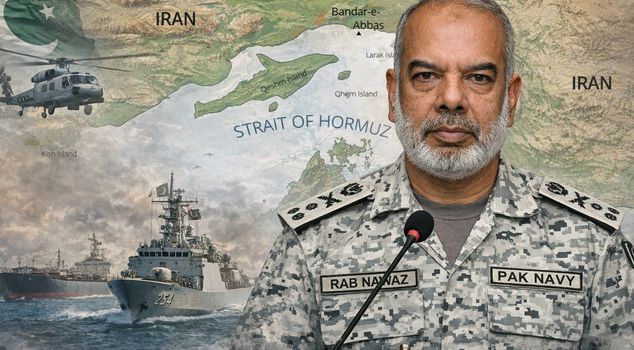
The Pakistan Navy became the first navy to organize safe passage through the region by providing secure escort for ships carrying oil and commercial cargoes despite the increasing risk of war in the Strait of Hormuz.
The attacks initiated by the US and Israel against Iran and Tehran's retaliations have severely affected ship traffic in the Strait of Hormuz, one of the most critical points of global oil trade. As insurance companies canceled war policies for ships in the region, many container and tanker companies suspended their transits through the Strait.
SHARP DECLINE IN SHIP TRANSITS
According to data from the UK Chamber of Shipping, an average of about 138 commercial vessels historically passed through the Strait of Hormuz daily. However, following the attacks by the Iranian Revolutionary Guards, particularly targeting commercial vessels linked to the US and Israel, this number experienced a significant decline.
PAKISTAN NAVY ACHIEVED A FIRST
As security risks in the region increased, the Pakistan Navy escorted aircraft carriers and supply ships safely from the Strait of Hormuz to Pakistan, securing all cargo, including oil. Thus, it became the first navy to conduct such a security operation in the risk environment of the region.
DAILY FLOW OF 20 MILLION BARRELS OF ENERGY
The Strait of Hormuz, located at the exit of the Persian Gulf, connects Middle Eastern oil production to global markets via the Oman Sea and the Indian Ocean. According to information compiled by AA correspondent, an average of 15 million barrels of crude oil and 5 million barrels of petroleum products were shipped through the Strait last year. Thus, the total daily oil volume reached approximately 20 million barrels.
COULD BE THE LARGEST SUPPLY SHOCK IN OIL MARKET HISTORY
If the current crisis disrupting the oil flow in the Strait continues, it is estimated that the supply, which constitutes about 20% of global oil demand, could be directly affected. Experts believe that such a magnitude of disruption could surpass all supply shocks seen in modern oil markets to date.
PAST OIL CRISES SHOW THE MAGNITUDE OF THE RISK
Past oil crises reveal the scale of the current risk. During the 1973 oil embargo, approximately 4.3 million barrels of oil were withdrawn from the global market daily, and this loss corresponded to 7.4% of the period's demand.
During the 1978-1979 Iranian Revolution, approximately 5.6 million barrels were lost daily, and in the Iran-Iraq War in 1980, about 4.1 million barrels of oil supply were lost. In the Iraq-Kuwait War in 1990, there was a daily loss of approximately 4.3 million barrels of supply.
In an older example, during the 1956 Suez Crisis, about 2 million barrels of oil supply were rendered unavailable daily. However, in absolute volume terms, this loss falls significantly short of the potential disruptions that could arise in the Strait of Hormuz.
GLOBAL ENERGY MARKET ON ALERT
According to experts, the current crisis in the Strait of Hormuz poses the greatest risk of supply shock that oil markets could face to date, both in terms of the ratio to global demand and absolute volume.