30.08.2024 08:10
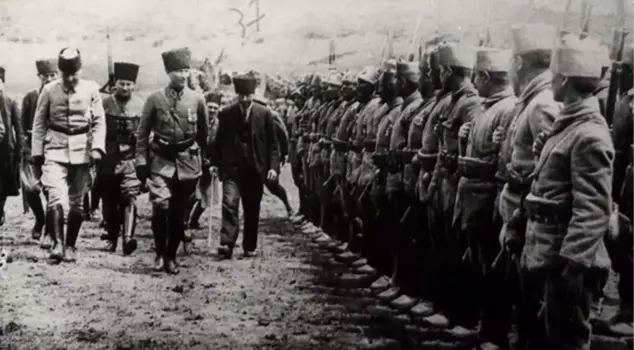
One of the greatest epic tales of heroism is August 30th... Today marks the 102nd anniversary of the Great Offensive and the Commander-in-Chief Battle, which began on August 26th, 1922, and was crowned with victory on August 30th, led by the Great Leader Mustafa Kemal Atatürk and the Turkish army.
The Great Offensive, which was initiated under the leadership of Great Leader Mustafa Kemal Atatürk on July 26, 1922, and crowned with the Victory on August 30, known as the Commander-in-Chief Battle, is remembered as a unique epic of heroism engraved in golden letters in the history of the Turkish army.
According to the information collected by AA correspondent, after the First World War in 1919, the Allied Powers, based on the Armistice of Mudros, disarmed the Turkish army and attempted to invade Anatolian lands. However, this invasion attempt would be stopped in the face of the nation's desire for independence and freedom.
THE OCCUPATION OF THE ALLIED POWERS AND THE NATIONAL STRUGGLE
In the days of occupation described in Halide Edip Adıvar's book "The Turkish Ordeal with Fire", the Allied fleet settled in Istanbul, the French settled in Adana, the British settled in Urfa, Maraş, Samsun, and Merzifon, and the Italians settled in Antalya and the southwest of Anatolia.
On May 15, 1919, with the permission of the Allied Powers, the Greek Army made a landing in Izmir.
In the face of this situation, the Turkish nation initiated the National Struggle against the occupations with the "consciousness of being a nation" it has shown throughout history. There were two options: either surrender to the occupying forces or rebuild a country that was destroyed and rise from its ashes.
After the opening of the Grand National Assembly of Turkey in 1920, the occupying forces intensified their oppressive policies against Atatürk and his comrades, especially in the Western Front. The Greek army reached Polatlı in 1921. The preparations for the longest-lasting battlefield in history were being made in Polatlı.
"THERE IS NO LINE OF DEFENSE, THERE IS A LINE OF DEFENSE"
The Battle of Sakarya, fought by the Turkish army against the Greek army in the Sakarya region, began on August 23. From this date onwards, in the relentless war that lasted day and night, Mustafa Kemal Pasha implemented a new war strategy and gave the order to his armies: "There is no line of defense, there is a line of defense. That line is the whole homeland. Every inch of the homeland cannot be abandoned until it is soaked with the blood of its citizens."
The Turkish military defended their homeland with all their might in accordance with this order. This relentless struggle lasted for 22 days and 22 nights. The Turkish army, which continued its attack along the entire front, cleared the Greek forces from the east of the Sakarya River on September 13, 1921.
The Battle of Sakarya took its place in history as one of the turning points where the Turkish nation transitioned from a defensive position to an offensive position.
After a preparation period of about a year with the aim of completely expelling the enemy army from the country, on August 26, 1922, Commander-in-Chief Mustafa Kemal Pasha gave the order to launch the Great Offensive.
MORNING OF AUGUST 26
Commander-in-Chief Mustafa Kemal took his place in Kocatepe, which is located within the borders of Afyonkarahisar, on the morning of August 26, together with Chief of General Staff Fevzi Pasha (Çakmak) and Western Front Commander İsmet Pasha (İnönü) to lead the battle.
In the continuation of the operation that started with artillery fire at dawn, the Turkish army launched an attack with the first light of the morning and captured Tınaztepe and pushed the enemy away from Belentepe and Kalecik Sivrisi.
On the first day of the offensive, the 1st Army units captured the enemy's first-line positions in a 15-kilometer area between Büyük Kaleciktepe and Çiğiltepe. The 5th Cavalry Corps launched successful attacks on the enemy's transportation lines behind the front, and the 2nd Army continued its reconnaissance mission without interruption on the front.
The Turkish army launched a new attack on all fronts on the morning of August 27 and on the same day, Afyonkarahisar was liberated from enemy occupation by the 8th Division. The successful offensive continued on August 28 and 29, resulting in the neutralization of the enemy's 5th Division.
During the night of August 29, the commanders made an assessment of the situation and unanimously agreed to take immediate action and ensure that the offensive is concluded without interruption on August 30. Necessary measures were taken for the implementation of the plan.
THE GREAT VICTORY
On the eve of the most important victory achieved by the Turkish army in the War of Independence, Commander-in-Chief Mustafa Kemal Pasha gave the order to attack the enemy forces in Altıntaş district of Kütahya, which is now a town, on the morning of August 30.
With the complete encirclement and destruction of the Greek forces in Dumlupınar in the Field Battle that started on August 26, the Turkish army under the command of Great Leader Mustafa Kemal Atatürk achieved victory. Some Greek units in the Kızıltaş Deresi region fled from the open area, including General Trikopis, General Diyenis, and many Greek commanders.
The day after the Great Victory, on August 31, Commander-in-Chief Mustafa Kemal, Fevzi Pasha, and İsmet Pasha evaluated the situation in Zafertepe Çalköy, placing the map of the battlefields on a broken cart in the garden of a house. They agreed to enter Izmir to prevent the Greeks from returning to their defensive positions and to defeat them.
"ARMIES, YOUR FIRST GOAL IS THE MEDITERRANEAN, FORWARD!"
After the Great Victory, on September 1, Mustafa Kemal Pasha issued a statement to be read to all officers and soldiers in the Western Front, stating:
"The armies of the Grand National Assembly of Turkey, in the Battle of Afyonkarahisar-Dumlupınar, have destroyed the fundamental existence of a cruel and arrogant army in an unbelievably short time. You have proven that you are worthy of the sacrifices of our great and distinguished nation. The great Turkish nation, which is our owner, is right to trust in its future. I am closely watching and following your successes and sacrifices on the battlefields.
I will not abandon the duty of conveying the praises of our nation to you, and I will constantly fulfill this duty. I have ordered the proposal for rewards to be submitted to the Commander-in-Chief. I request that all my comrades continue to advance, taking into account that there will be other battles in Anatolia, and compete with all their might, using their mental power and the resources of their patriotism. Armies, your first goal is the Mediterranean, forward!"
In accordance with this order, the Turkish army, advancing from three fronts, recaptured Gediz and Uşak on September 1, Eskişehir on September 2, Balıkesir and Bilecik on September 6, Aydın on September 7, and Manisa on September 8. On September 9, the Turkish army, which drove the Greek army into the sea in Izmir, successfully carried out the order of Mustafa Kemal Pasha.
"BECAUSE I COULD NOT KEEP MY PROMISE, I CANNOT LIVE"
One of the most important events that remained in memory from the Great Offensive was the suicide of Colonel Reşat Bey, the commander of the 57th Division, due to the delay of half an hour in capturing Çiğiltepe on August 27.
When Colonel Reşat Bey called the 57th Division Command again on the slopes of Çiğiltepe and was told that he had committed suicide, he wrote, "Because I could not keep my promise to capture that position within half an hour, I cannot live.""The note was read.
Çiğiltepe was liberated from enemy soldiers 15 minutes after the death of Colonel Reşat Bey.
"THE IMMORTAL EXISTENCE OF THE TURKISH REPUBLIC WAS CROWNED HERE"
Great Leader Atatürk arrived in Zafertepe Çalköy to attend the groundbreaking ceremony of the Martyr Sancaktar Mehmetçik Monument on August 30, 1924, 2 years after the Great Victory.
Reminding the attendees of two years ago, Atatürk described the Great Victory with the following words:
"The Battle of Afyonkarahisar-Dumlupınar and its final part, the Victory of August 30, is the most important turning point in Turkish history. Our national history is filled with great, brilliant victories, but I do not remember a decisive and influential battle in our history, not only for our history but also for world history, like the victory our Turkish nation achieved here. It is obvious that the foundation of the new Turkish state, the young Turkish Republic, was solidified here, and its immortal existence was crowned here. The Turkish blood shed on this field, the martyr spirits flying in these skies, are the immortal protectors of our state, our Republic. With the victory it achieved here, the Turkish nation once again engraved this certain truth into the heart of history with its strength and will. "
August 30, which was first celebrated as Victory Day in 1926, is celebrated every year with various events throughout the country and in the TRNC.
."