03.04.2026 15:43
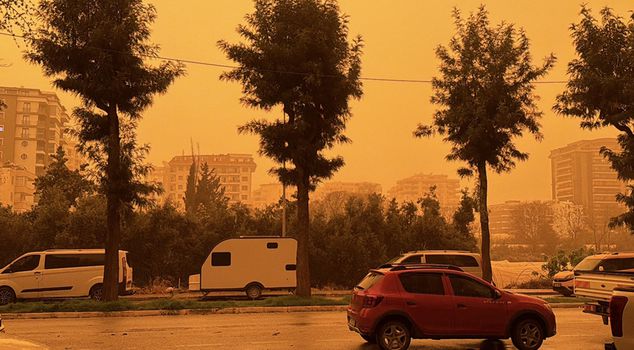
Dust transport from North Africa turned the sky red in Antalya. As air quality experienced a serious decline, asthma and COPD patients struggled to breathe. With the rain, the desert dust turned into mud. Parked vehicles, balconies, and surfaces in open areas were seen covered in mud. Adana and Hatay were also affected by the desert dust.
The dust transport entering Turkey from North Africa negatively affected life in Antalya, Adana, and Hatay. The effective dust transport turned the sky almost red, and there was a significant drop in air quality. It was reported that those with chronic conditions such as asthma and COPD had difficulty breathing.
IT AFFECTED ANTALYA THE MOST
The dust transport became effective in Antalya from the morning hours. Due to the dust transport that negatively affected life, the silhouette of the city and buildings became invisible from many points. In the city where visibility decreased, air quality also dropped due to the dust. The Bey Mountains surrounding the city became invisible due to the dust, and the sky was seen to turn gray.
According to meteorological data, Antalya was the place where the dust transport was most intense. The daily average dust concentration reached 217 micrograms per cubic meter in Antalya, while the closest value to this was measured at 162 micrograms per cubic meter in Hatay. In a warning made by the Meteorology 4th Regional Directorate, it was stated that "Since the dust transport is expected to continue intensely in some places, it is necessary to be careful and take precautions against negative impacts such as a decrease in air quality, a drop in visibility, and disruptions in transportation."
DESERT DUST TURNED INTO MUD
In Alanya, the color of the sky changed due to the effect of desert dust in the morning hours. As rain also became effective in the district, the desert dust turned into mud. While vehicles were covered in mud, drivers experienced difficult moments. According to information obtained from the Alanya Meteorology Directorate, it was learned that the desert dust would only be effective in the district today. In the Manavgat district, rain and short-term hail also showed their effects along with the desert dust. In the ancient Side region, muddy water puddles formed on the walking paths due to the effects of desert dust, rain, and hail.
IN HATAY AND ADANA, VISIBILITY WAS ALSO POOR
The low-pressure system over the Central Mediterranean and the desert dust transported from the Sahara became effective in the Samandağ district of Hatay. While life was negatively affected in the district, due to the effective desert dust, roads and the sea became invisible in some places. Due to the dense dust cloud, drivers had difficulty progressing in traffic. In the İskenderun district, the dense dust cloud also negatively affected life.
With the arrival of the desert dust transported from North Africa to the Eastern Mediterranean line, it also became effective in Osmaniye and Adana after Hatay. The dust cloud that was effective in the Kadirli district of Osmaniye and the city center of Adana occasionally reduced visibility.
Here are the images from the region:
Source: AA, DHA