19.12.2025 13:35
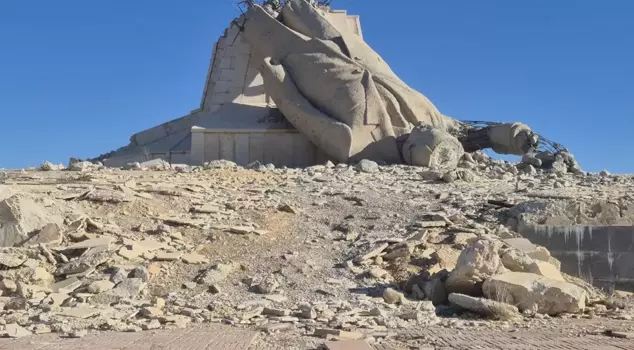
After the fall of the Assad regime in Syria last year, the largest statue of Hafez Assad, located at a point known as "Statue Hill," remains toppled by the people who brought heavy machinery to the site. Even after a year, the statue, still in a fallen state, continues to exist as a tangible proof of the closing of an era that has ruled the country in recent years and the determination of the Syrians in their struggle for freedom.
The bloody dictatorship period of over 50 years led by former Syrian President Hafez al-Assad, who came to power through a coup in 1971, and his son Bashar al-Assad, who took over after his death in 2000, came to an end with the entry of the opposition into Damascus on December 8, 2024.
ONCE AGAIN CAPTURED
The collapse of the Baath regime led by Bashar al-Assad was celebrated for days both in the country and in various parts of the world. A year after Assad's overthrow, the statue of Hafez al-Assad, which was destroyed by Syrians during last year's celebrations, was captured once again.
SYMBOLIZING THE VICTORY OF THE PEOPLE
Located in the town of Deir Atiyah, approximately 88 kilometers north of the capital Damascus, between the cities of Homs and Damascus, the monument, which was once the largest statue of Hafez al-Assad in the country, today symbolizes the victory of the people in its destroyed state.
STILL IN A COLLAPSED STATE
Despite a year passing since the statue was destroyed, it still stands in a collapsed state. The debris of the shattered statue continues to exist as a tangible proof of the closing of an era that ruled the country in recent years and the determination of the Syrians in their struggle for freedom.
THE LARGEST OF 3 THOUSAND STATUES
The statue of Hafez al-Assad in Deir Atiyah, the largest among approximately 3,000 statues across the country, was built on a high hill overlooking the strategic Homs-Damascus highway. The giant statue, carved from marble by Mahmud Shahin, a faculty member of the Faculty of Fine Arts at Damascus University in the 1980s, was financed by Muhammed Daabul, who served as the head of the Presidential Office for over 40 years.
TOPPLED BY THE PEOPLE
On December 8, 2024, following Bashar al-Assad's escape to Russia and the overthrow of the regime, the people of Deir Atiyah in the Qalamoun Mountains region took action early in the morning. The people, who reached the site known as "Statue Hill" with construction machinery, brought down the statue in a historic moment that demonstrated the people's anger and their will to erase the traces of the past.