26.02.2026 13:30
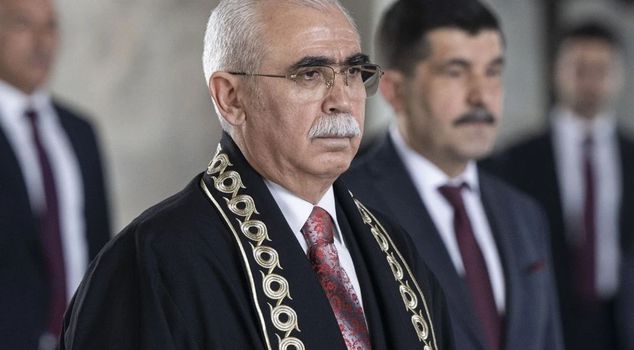
The President of the Constitutional Court, Kadir Özkaya, answered questions regarding the HDP, Selahattin Demirtaş, and Can Atalay. Özkaya stated that they do not have the authority to implement the European Court of Human Rights' violation ruling concerning Selahattin Demirtaş, and regarding the closure case of the HDP, he mentioned that the file is technically nearing its conclusion.
The President of the Constitutional Court, Kadir Özkaya, answered questions from the press regarding the HDP, Selahattin Demirtaş, and Can Atalay.
Özkaya met with representatives of press organizations in Ankara at an iftar held at the Ankara Provincial House.
In his speech here, Özkaya stated that they attach importance to technological transformation to increase the effectiveness of legal remedies, recalling that they enabled individual applications to the Constitutional Court to be made electronically and through the UYAP Lawyer Portal as of October 1, 2025.
Özkaya reported that since October 1, 2025, there have been 6,686 individual applications made using this method, emphasizing that this application has increased accessibility and opened the way for application processes to be conducted more quickly, effectively, and transparently.
Özkaya also mentioned that they are conducting serious studies on the use of artificial intelligence to assist in the work within their jurisdiction and the reporting institution.
Özkaya informed that in 2025, there were 64,321 individual applications made to the Constitutional Court, and 71,175 applications were concluded, indicating that the number of decisions given exceeds the number of applications made, which shows that despite the increasing workload, the Constitutional Court works with great dedication and effort.
"87.2% OF INDIVIDUAL APPLICATIONS HAVE BEEN DECIDED"
Özkaya provided the following information regarding individual applications made to the Constitutional Court:
"From the date it came into effect on September 23, 2012, until December 31, 2025, a total of 714,774 applications were made under the individual application system. Approximately 623,088 of these, or 87.2%, have been decided. Currently, 91,686 applications are still pending. In 2025, a violation decision was made in 5,268 of the applications concluded. None of these involve a violation of reasonable time. These are violations related to qualified rights. The number of violation decisions given from September 23, 2012, to December 31, 2025, is 84,519. Of these, 56,443 are related to the right to a fair trial within a reasonable time. The number of violation decisions based on rights is 28,076. Among these 28,076 violation decisions, the majority are related to the right to a fair trial and the right to property."
Özkaya stated that the ratio of the total number of violation decisions given to the total applications, excluding reasonable time, is approximately 3.9%, and he used the expression, "This actually indicates that the Constitutional Court does not act as a super appellate court in individual application reviews, but only examines whether a right has been violated in a constitutional sense."
Özkaya noted, "Our court has contributed to making constitutional principles more visible and functional with the important decisions it has made in individual applications." He emphasized that in this respect, the individual application is a dynamic and transformative mechanism that allows the Constitution to be a living document.
"THE INDIVIDUAL APPLICATION SYSTEM CONTINUES SUCCESSFULLY"
Özkaya pointed out that the implementation of violation decisions given under individual applications is carried out within certain procedures and processes, and continued his remarks as follows:
"In this context, as of December 31, 2025, the number of violation decisions that have not yet been executed is 83. A significant portion of these execution processes is still ongoing. It is observed that the reason for the small remaining portion not having completed the execution process is due to the different interpretations of the violation reasons stated in the violation decisions or the legislation that needs to be applied after the violation decision by the Constitutional Court. Of course, the low ratio of files for which the execution process has not yet been completed should not be understood as this issue being insignificant. These are indeed very important decisions.
On the other hand, I must also express that as of December 31, 2025, we see that 99.7% of the violation decisions given by our court have been implemented. Essentially, this picture shows us that the individual application is an effective and functional legal remedy in the context of the protection of fundamental rights and freedoms. Therefore, I can confidently state that the Constitutional Court continues to implement the individual application system, which was brought to life based on the authority granted by our noble nation in 2010, with great determination and success."
"THERE ARE NO PENDING SUPREME COURT CASES"
Özkaya reported that under the "norm control" framework, there were 277 applications made to the Constitutional Court in 2025, including 51 annulment cases and 226 objections, while 278 annulment cases and objection applications were concluded in 2025, and the constitutionality of 472 rules was examined.
Özkaya provided the information that "from 2012 to December 31, 2025, a total of 2,328 annulment cases and objection applications were made. The number of cases concluded during the same period is 2,322. As of this date, the number of pending cases is 114."
Reminding that another duty of the Supreme Court is the trials of the Supreme Council, Özkaya stated that Turkey has experienced an extraordinary process following the coup attempt on July 15, 2016, and that judicial activities have also been affected by this process.
Özkaya explained that this process has also reflected on the trials of the Supreme Council, stating, "In this context, our court has concluded 12 Supreme Council cases as a result of the trials it has conducted since 2017, and has issued judgments against 32 individuals in these trials. As of the end of 2025, there are no pending Supreme Council cases."
"THE NUMBER OF PENDING PARTY CLOSURE CASES HAS REACHED 5"
Özkaya reported that the Constitutional Court also conducts financial audits of political parties, noting that 164 cases were concluded in this context in 2025.
Özkaya stated that they are working in coordination with the Court of Accounts regarding the financial audits of political parties, saying, "Currently, the financial audits of 188 active political parties are being conducted. Additionally, to facilitate the financial audits of political parties, work is underway to prepare a Political Party Financial Audit Guide, which outlines the decisions made by the Constitutional Court and the criteria monitored by the Constitutional Court, under the coordination of one of our chief rapporteurs, and this guide will hopefully be completed soon."
Özkaya expressed, "Among the duties assigned to our court by the Constitution is to decide on the closure cases of political parties. As of the end of 2025, I would like to state that the number of pending cases regarding party closure is 5."
THE HDP CLOSURE CASE AT THE CONSTITUTIONAL COURT
After his speech, Özkaya answered questions from the press, stating, "The Constitutional Court has not yet made a decision regarding the closure case opened against the HDP.
What is the latest status of the case?" he answered:
"It is a very comprehensive case. The examination and investigation of the issues raised in the indictment will take a considerable amount of time. From the beginning, we assigned 4 reporters to the file. Although many closure cases have been filed with the Constitutional Court to date, there is no other case of the same nature as the HDP closure case. The actions of 520 individuals are cited as grounds for the closure case. A ban decision is requested for 451 of these individuals. We are talking about 4,000 actions concerning 520 individuals. All of these actions have been the subject of investigation and prosecution.
This corresponds to approximately 3,000 cases. We are talking about a case with an indictment of 840 pages, 60 folders attached, and about 200 GB of digital material within these folders. Technically, we can say that we have reached the end of the file. In other words, we are approaching the completion process. In other words, it is at the stage where the Constitutional Court will begin its main examination. An evaluation can be made without taking a long time."
Özkaya, in response to the question regarding "the Supreme Court's criminal chamber filing a criminal complaint against the members of the Constitutional Court," stated, "No verbal or physical action has been taken by the Constitutional Court. The process has not continued anyway. So it remained only with the decision being made, and there has been no further development afterward. The Constitutional Court has not taken a stance on this matter either."
RESPONSE TO THE QUESTION ABOUT SELAHATTİN DEMİRTAŞ
In response to the question regarding "the failure of the courts to implement the violation decisions given by the Constitutional Court and the European Court of Human Rights (ECHR) regarding Can Atalay, whose parliamentary membership was revoked, and former HDP Co-Chair Selahattin Demirtaş," Özkaya recalled that the Constitutional Court has made 3 decisions regarding Atalay.
Recalling that he expressed his judicial opinion in these decisions as a member of the Constitutional Court, Özkaya stated, "I have signed two decisions stating that the prosecution of Can Atalay as a member of parliament is subject to special procedure and that the prosecution should be suspended as long as he retains his status as a member of parliament, in accordance with the interpretation of Articles 14 and 83 of the Constitution."
Özkaya noted that as the Constitutional Court, they examined the essence of the applications made regarding the failure to implement the violation decisions given by the ECHR and stated that if they determine that the violation decision has not been implemented, they issue a violation decision. "We do not have the authority to ensure the implementation of the violation decisions of the European Court of Human Rights. Therefore, our evaluations on this matter can also be interpreted differently. For this reason, I think it would be more appropriate to evaluate these kinds of issues with our decisions," he said.
"WE AIM TO IMPLEMENT ARTIFICIAL INTELLIGENCE BY SEPTEMBER"
In response to the question, "In which areas will the Constitutional Court use artificial intelligence, and can you provide a date for the transition to artificial intelligence?" Özkaya stated:
"We aim to implement artificial intelligence by September 2026. In the first phase, we plan to utilize artificial intelligence for reading, summarizing, and categorizing individual application forms. I would like to emphasize this point: we will not attribute legal value to the work of artificial intelligence and the product that emerges from these studies. In other words, artificial intelligence will provide contributions in the nature of preparatory work for our reporters. The product generated by artificial intelligence will definitely be checked by the reporters, the accuracy of these outputs will be tested, and after the necessary controls, those studies will be utilized.
As a second phase, we aim to utilize artificial intelligence in the categorization of files before the evaluation stage of the files. At this point, artificial intelligence can make suggestions regarding the files based on the previous decisions made by the Constitutional Court on similar issues. This process will also be implemented after passing through control, being tested, and determining that the error rate is very low. All these applications will be active in the initial examination phase of the files; however, the involvement of artificial intelligence in the examination phase of the essence of the file, that is, in situations requiring legal evaluation such as whether there is a violation in the file, will not be the case at this time."