01.04.2026 12:11
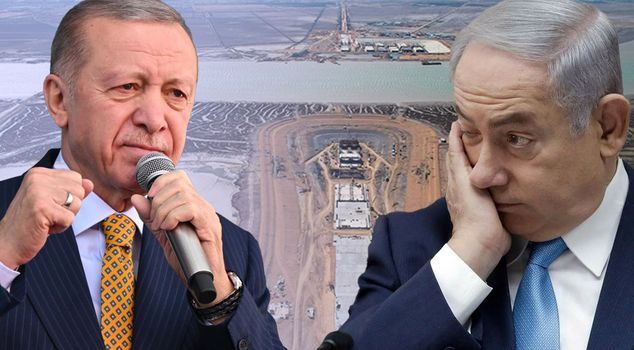
The Iran war and the Hormuz Strait crisis brought Turkey's Development Path into confrontation with Israel's IMEC project, while Ankara's moves heightened the concern of "being sidelined" within the Tel Aviv administration.
The war in Iran and the potential blockade in the Strait of Hormuz are reshaping trade routes between Asia and Europe, highlighting two major projects in the region. The competition between the Israel-led IMEC project and Turkey's Development Road initiative has transformed into an economic and geopolitical struggle that goes beyond military strategies.
DISCOMFORT IN TURKEY IN ISRAELI PRESS
Analyses in the Israeli press reveal that Ankara's recent diplomatic and economic steps have raised concerns of "being sidelined" within the Tel Aviv administration. According to a report by Maariv newspaper, it was suggested that Turkey and Syria are pursuing a joint strategy to prevent Israel from becoming the gateway to Europe. Retired Colonel Amit Yagur, a former senior military official in Israel, argued that the bloc led by Turkey is attempting to eliminate Israel from the equation, stating that there is a strong geopolitical calculation behind these moves.
ALTERNATIVE ROUTES IN ASIA-EUROPE TRADE
New trade corridors to be established overland between Asia and Europe have the potential to reduce dependence on maritime passages such as the Suez Canal and the Bab el-Mandeb Strait. Experts believe these new routes could shorten shipping times by one-third. The conflicts in Iran and uncertainties in the Strait of Hormuz have turned these projects from theoretical discussions into an urgent necessity.
IMEC PROJECT: A NEW ROUTE FROM INDIA TO EUROPE
The IMEC project, which includes Israel, was announced at the G20 Summit in India in September 2023. Supported by the USA, India, and Saudi Arabia, the project envisions the transportation of goods from India to Israel's Haifa Port via the United Arab Emirates, Saudi Arabia, and Jordan, and then to Europe. It is estimated that the approximately 2,000-kilometer land route reduces the distance by 4,000 kilometers compared to maritime transport through the Suez Canal. Following Indian Prime Minister Narendra Modi's visit to the USA in February 2026, the project gained momentum again, with US President Donald Trump stating that this route would be "one of the largest trade routes in history."
DEVELOPMENT ROAD PROJECT: TURKEY'S STRATEGIC MOVE
Turkey is implementing the Development Road Project as an alternative to IMEC. Led by President Recep Tayyip Erdoğan, the project aims to connect the Al-Faw Port in southern Iraq to Europe via Turkey. A consensus has been reached among Turkey, Iraq, Qatar, and the UAE for the project, which covers an approximately 1,200-kilometer corridor.
Transport Minister Abdulkadir Uraloğlu announced that an investment of approximately 20 billion dollars is planned for the project. The system, which will be integrated with Turkey's railway network, aims to provide uninterrupted access from the Persian Gulf to Europe via high-speed trains.
DEVELOPMENTS IN SYRIA HAVE CHANGED THE BALANCE
The political change in Syria in December 2024 paved the way for the resumption of overland transportation between Turkey and Gulf countries. Turkey's plan to establish a new trade route extending to the Gulf through Syria and Jordan has reshaped the economic balances in the region. The Syrian administration also stated that in the event of a possible crisis in the Strait of Hormuz or the Red Sea, the country's strategic position could become an alternative logistics center.
The Syrian administration also stated that in the event of a possible crisis in the Strait of Hormuz or the Red Sea, the country's strategic position could become an alternative logistics center.
BILLIONS OF DOLLARS RISK FOR ISRAEL
Experts point out that approximately 21 million barrels of oil and a significant portion of global liquefied gas trade passing through the Strait of Hormuz are linked to this route. A potential crisis could severely disrupt global trade flows.
Israeli experts warn that if the new trade corridor led by Turkey is realized, Israel's regional economic role may weaken, and it could face the risk of billions of dollars in losses.