29.12.2025 10:15
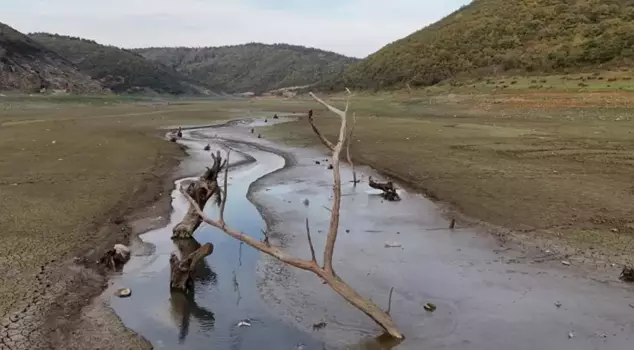
With the decrease in rainfall in Istanbul, the water level in the reservoirs has dropped to around 17%. Zafer Murat Çetintaş, the Secretary General of the Istanbul Environmental Council, pointed out that the reason for the insufficient filling of the reservoirs is the closed streams. He stated, "When we consider that all of the approximately 4.5 million homes and workplaces in Istanbul are burning natural gas at the same time, we are heating the air in Istanbul. We are preventing the rain clouds from raining."
The increasing population, unconscious water consumption, broken faucets, closed streams, and global warming are just a few of the many reasons that water scarcity is becoming a more pressing issue in large cities.
According to İSKİ data, the overall reservoir filling rates in Istanbul have dropped to around 17 percent. The reason for Istanbul not receiving as much rainfall as before is attributed to heat islands caused by the increasing population and natural gas usage. Experts state that when rain clouds approach the city, they disperse due to these heat islands. Additionally, it is expressed that many seemingly small factors in the city contribute to drought. Broken faucets, excessive sink water usage, and car cleaning are significant areas of consumption on an annual average. Desalination of seawater and cloud seeding with silver iodide are among the most prioritized solutions.
"WE ARE ON THE BRINK OF FACING WATER SCARCITY"
Zafer Murat Çetintaş, Secretary General of the Istanbul Environmental Council, stated that the city is facing a water problem and that solutions need to be implemented as soon as possible. "Having the reservoirs in Istanbul at 100 percent capacity is only sufficient for 5-6 months. The water problem in Istanbul has never ended, but there are solutions. We are on the brink of facing water scarcity at any moment. In the past, there were 123 streams in Istanbul, most of which have been closed, destroyed, or built over. Generally, 70 percent of rainwater goes to the seas, whereas in the past it went to the reservoirs. There are about 4.5 million buildings in Istanbul, and when we add workplaces and industrial areas, the number increases significantly. A family of four consumes 16 liters of water when they use the toilet. That means 7 tons of water consumption per month. Consider that there are 2 million broken faucets; a broken faucet consumes 750 liters of water per month. There are approximately over 5 million registered cars in Istanbul. We also experience significant water loss for cleaning them," he said.
125 CITIES AROUND THE WORLD USE DESALINATED SEAWATER
Çetintaş expressed that a bleak future awaits Istanbul due to water scarcity, stating, "Desalinated seawater is used in 125 cities around the world. The most suitable points for using desalinated seawater in Istanbul are the Papuçdere and Kazandere reservoirs. A desalination facility built here could solve Istanbul's water scarcity. This is because the salinity level of the Black Sea is 0.5 percent, making it easy to desalinate. This should be one of our biggest solutions. İSKİ should initiate a project to repair broken faucets through its 'Tap Water is Ours' campaign. To use less water when flushing toilets, a 2-liter water bottle should be placed inside. We forget everything when we have water, and then we remember when drought knocks on our door," he said.
"RAIN CLOUDS ARE DISPERSED DUE TO HEAT ISLANDS"
Çetintaş continued his remarks as follows:
"When we consider that all approximately 4.5 million homes and workplaces in Istanbul are burning natural gas at the same time, we are heating the air in Istanbul. We are preventing rain clouds from raining. When rain clouds approach the city, they disperse because the heat vapor there destroys them. Rain clouds are dispersed due to heat islands. İSKİ needs to seed clouds to induce rainfall. Cloud seeding with silver iodide is necessary to make it rain. For the rain to fill the reservoirs, it needs to rain continuously for 28 days. When there is intense snowfall for 10 days, it helps fill the reservoirs."