04.04.2026 14:21
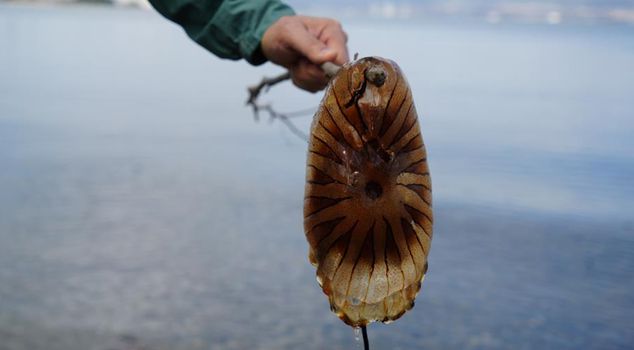
Recently, the number of compass jellyfish rapidly increasing in the Gulf of Izmit has caught the attention of those walking along the beach. Experts noted that this species, which stands out with its red color and long tentacles, can cause serious burning and pain upon contact, emphasizing that particularly incorrect interventions have worsened the situation.
The red-colored compass jellyfish, which attracts the attention of citizens walking on the beach, has started to be seen again along the shores of Izmit Bay. Experts stated that the scientific name of this species is Chrysaora hysoscella and that it can cause serious burning and pain, especially if touched on its tentacles. Prof. Dr. Halim Aytekin Ergül emphasized that this species should not be touched, and if contact occurs, it is important to wash the area with seawater, not freshwater.
Prof. Dr. Halim Aytekin Ergül, a faculty member of the Biology Department at Kocaeli University Faculty of Arts and Sciences, stated in a statement regarding the issue that this species is not new to Izmit Bay and has been encountered in the region's waters since 2007.
"SEEN IN IZMIT BAY SINCE 2007"
Ergül mentioned that the compass jellyfish stands out due to its unusual color and structure compared to common species, saying, "As far as I know, this species has been encountered in Izmit Bay since 2007. We had seen and reported it during a previous study; they are not very new. However, their images attract the public's attention naturally because they are different and colorful compared to the jellyfish we are used to or commonly found in our seas. During a field study we conducted last week, we also encountered them. Their density has increased recently. The end of winter and the beginning of spring coincide with their breeding periods. Therefore, their numbers increase during this time due to their normal physiological processes. It is a natural process for them to be found in Izmit Bay right now," he said.
"DO NOT TOUCH THE TENTACLES, DO NOT WASH WITH FRESHWATER"
Prof. Dr. Ergül drew attention to the fact that the jellyfish's stinging capsules are only found in the tentacle parts and listed what should be done in case of possible contact:
"Under normal conditions, these creatures do not harm humans. However, when touched, especially the tentacle parts, the stinging capsules contained in the needles called cnidocytes can cause a burning sensation and pain. They consist of two parts: tentacles and the umbrella part. There is no harm in touching the umbrella part, but the tentacle part, which contains the needles I mentioned, can cause harm. It is recommended to wash the painful area with seawater in case of contact. Freshwater or tap water should not be preferred as it can cause the cnidocytes to burst and increase the pain. In the later stages, if available, water with ammonia or vinegar may be a suitable treatment method for this. It is also beneficial to go to a healthcare institution afterward."
"MAY HAVE BEEN TRANSPORTED BY BALLAST WATER FROM SHIPS"
Ergül noted that there are different hypotheses regarding the arrival of the species to the region, stating, "It is highly likely that they have been transported through the ballast water of ships. Additionally, the increase in water temperatures due to climate change and the decrease in their predators also contribute to the population's establishment and increase in this region."
"POPULATION WILL BALANCE"
Emphasizing that the numerical increase is directly related to the physicochemical conditions in the water, Ergül stated, "One of the reasons for the numerical increase may be related to the decrease in the number of their predators. Additionally, the temperature increases in surface waters affect the concentration of the species in the region during this period. However, there is no cause for concern; over time, the population sizes will definitely balance within the ecosystem's own dynamics," he said.
Ergül also emphasized the importance of citizens reporting the jellyfish they encounter through the Turkish Marine Research Foundation's (TÜDAV) "yayakarsa.org" site for the health of the seas and scientific data tracking.
"I SAW A RED, HUGE JELLYFISH WITH LONG TENTACLES WHILE WALKING WITH MY WIFE"
Bucak Sıcak, who recorded the images of the jellyfish after noticing it while walking on the beach, said, "I saw a red, huge jellyfish with long tentacles while walking with my wife. I suspected it could be a dangerous species. Children swim here in the summer, and some people go into the water. Someone might have an allergy, so I wanted to report the situation to raise awareness among people," he stated.