03.08.2026 11:09
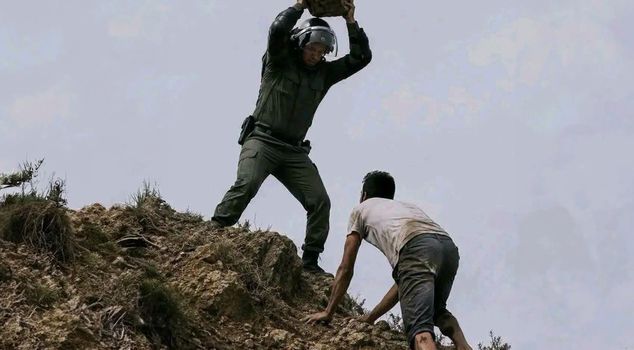
Approximately 69,500 irregular migrants who crossed from Morocco into Spain-controlled Ceuta have begun to return as their hopes of reaching Europe have faded. While a moment when a security officer struck a migrant trying to climb the rocks at the border line with a large stone drew backlash, the migration crisis also spread to Europe. Italy, France, and Portugal tightened border controls and implemented new security measures.
Approximately 69,500 irregular migrants who crossed from Fnideq in northern Morocco to the Spanish-administered enclave of Ceuta have begun returning to Morocco after their expectations of moving on to Europe were not met.
While it is noted that the pace of returns has accelerated along the border in recent days, the humanitarian crisis in the region is deepening.
STONE ATTACK DRAWS REACTION
As migrants continue to return, images from the border have caused a major outcry. In footage shared by local media and social media, a security officer is seen striking an irregular migrant, who was trying to move through a rocky area, with a large stone.
The images drew swift condemnation and brought the humanitarian dimension of the migration crisis back into the spotlight.
REASONS FOR THE RETURNS
The fact that many irregular migrants who reached Ceuta could not meet their basic needs, could not find shelter, and European countries announced they would not allow passage are cited as the main factors accelerating the returns.
Security measures in the region have also been raised to the highest level.
CRISIS SPREADS TO EUROPE
After approximately 50,000 irregular migrants reached Ceuta, the crisis made its way onto Europe's agenda.
The government of Italian Prime Minister Giorgia Meloni temporarily suspended the Schengen agreement with Spain and tightened border controls for those arriving by air and sea.
Italian Interior Minister Matteo Piantedosi announced that checks at sea and air borders would continue for one month.
Starting Saturday morning, random identity checks have been implemented at Rome Fiumicino, Milan Malpensa, and Milan Linate airports.
HOW WILL THE NEW CHECKS WORK?
Under the new practice, European Union citizens will only need to show their identification document.
Citizens of non-EU countries will be required to present a valid residence permit or visa in addition to their identification document.
The freedom of movement for EU citizens traveling from Italy to Spain will continue.
FRANCE AND PORTUGAL ALSO TAKE MEASURES
As the crisis grew, France also increased its controls on the border with Spain.
Portugal, on the other hand, tightened security measures on its southern border.
The measures taken across the European Union have reopened the debate on the balance between free movement in the Schengen area and border security, while also raising concerns, particularly for European tourism that spans multiple countries.