21.02.2026 14:35
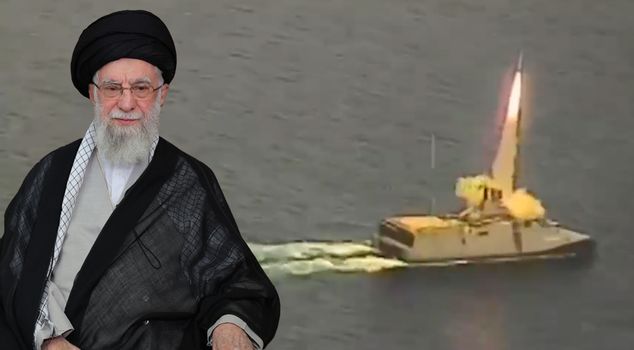
Iran, preparing for war with the U.S., successfully tested a new weapon. The Iranian Revolutionary Guard Corps Navy recently tested the ship-based air defense missile Seyyad 3-G for the first time during the "Smart Control of the Strait of Hormuz" exercise. The Seyyad 3-G, with a vertical launch capability and a range of 150 kilometers, provides the opportunity to create a regional air defense shield for ships.
While discussions continue about whether the U.S. will carry out a military attack on Iran, the Washington administration tested a new weapon in Iran while continuing to build up forces in the Middle East. The consecutive moves revealed that war is now a matter of time.
AIRCRAFT CARRIER IN THE MEDITERRANEAN
Following U.S. President Donald Trump's order to send a second aircraft carrier to the region after the tensions with Iran, it was reported that the Gerald R. Ford (CVN-78) Aircraft Carrier and its accompanying war frigate reached the Mediterranean after passing through the Strait of Gibraltar.
U.S. SOLDIERS EVACUATED
Officials from the U.S. Department of Defense speaking to the New York Times reported that hundreds of soldiers were evacuated from the Al-Udeid Air Base in Doha, the capital of Qatar.
Officials also stated that evacuations were carried out from bases in Bahrain where the U.S. Navy's 5th Fleet is stationed.
IRAN SHARED IMAGES OF NEW WEAPON
The Islamic Revolutionary Guard Corps shared images of the ship-based version of the ground-launched air defense system Seyyad 3-G being fired from the "Shahid Seyyad Shirazi" ship.
It is reported that the Seyyad 3-G, which has a vertical launch capability and a range of 150 kilometers, provides the possibility of creating a regional air defense shield for "Shahid Soleimani" class ships.
This system, which is reported to have independent detection and engagement capabilities, can be connected to an integrated command and control network and enhances the ships' capabilities against air threats.
The first long-range air defense missile named "Seyyad 3," produced in Iran, was tested on December 28, 2016. The "Seyyad 3," which has a range of 120 kilometers, is 6 meters long and weighs 900 kilograms.
The "Smart Control of the Strait of Hormuz" exercise began on February 16 and lasted for 3 days.
TRUMP: WE CAN SAY WE ARE CONSIDERING A LIMITED ATTACK
On the other hand, U.S. President Donald Trump made a new statement regarding a possible attack on Iran. When asked by reporters about the possibility of an attack on Iran, Trump said, "We can say we are considering a limited attack."
A U.S. official speaking to Reuters stated that the U.S. military plans regarding Iran are at a highly advanced level and include many options ranging from targeting individuals to regime change.
The U.S. military activity in the Middle East is described by former Pentagon officials and security experts as "extremely significant and extraordinarily rapid." Military strategy expert Becca Wasser stated that the buildup, especially in terms of air power, resembles the situation before the 2003 Iraq War.
ISRAELI ARMY ON HIGH ALERT
While activity continues on the U.S. side, the Israeli army announced that it is on high alert regarding a possible U.S. attack on Iran.
Israeli Army Spokesman Effie Defrin stated in a video message that they are closely monitoring regional developments regarding a possible U.S. attack on Iran.
Defrin said, "We are on high alert. Our eyes are open in every direction, and our fingers are more vigilant than ever to respond to any changes that may occur in operational reality."
Defrin also added that there have been no changes in the security instructions for the public from the Israeli Army Home Front Command and urged citizens to pay attention to official statements from the army.
Israeli media reported that the Israeli Army Home Front Command was instructed to go on high alert following assessments that the U.S. could launch a possible attack on Iran "soon."
Channel 12 television suggested that if the U.S. were to launch an attack on Iran, Israel would also participate in those attacks.
U.S. officials speaking to Israeli media indicated that Trump is "very close" to giving an order for a large-scale attack on Iran, noting that the diplomatic window is narrowing and military options are on the table.
IRAN: RETALIATION WILL BE GIVEN
On the other hand, Iran's Permanent Representative to the United Nations (UN) Amir Said Iravani stated, "In the event of a military attack, Iran will respond decisively and proportionately by exercising its right to self-defense under Article 51 of the United Nations (UN) Charter."